
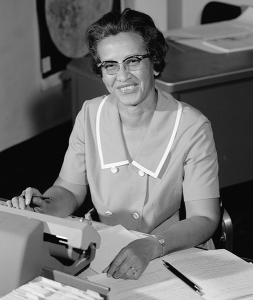
When we reflect back upon women who have made incomparable contributions to science, it is important that we remember Katherine Johnson, one of the first African American women to work for NASA as a scientist and “human computer.” She was tasked with mapping out the trajectory, launch windows, and emergency return path for Project Mercury, making it possible for astronaut Alan Shepard to lead the historic journey in which he became the first American to reach space. Her calculations also helped astronaut John Glenn to become the first American to orbit Earth. Yet, her proudest achievement was her work on the Apollo 11 mission in which Neil Armstrong became the very first human being to walk on the surface of the moon. It is not an exaggeration to say that Katherine Johnson changed the course of history and space travel for the entire world.
As a child, Johnson was a gifted learner whose parents made considerable sacrifices to send her to the best school possible. The neighborhood teachers could barely keep up with her academic prowess as her journey into mathematical genius began to take off. As a result, at the youthful age of thirteen Katherine transferred to a high school that was located on the campus of West Virginia State College. It was at this historically Black college where she earned a bachelor’s degree in mathematics and French. She was well on her way to achieving success, but who could have known how far this path would ultimately take her?

In 1938, Katherine was one of four students (and the only woman) selected to integrate West Virginia University’s graduate program. Under the historic U.S. Supreme Court decision Missouri ex rel. Gaines vs. Canada, the court ruled that institutions of higher education in the United States which educated whites in graduate programs were legally obligated to offer the same opportunity to people of color. She overcame a number of obstacles in order to achieve her doctorate degree as a Black woman living during a time of pervasive racism – some of which were depicted in Hidden Figures, the 2016 feature film in which Taraji P. Henson played the role of Katherine Johnson. The film also showed how Johnson’s mathematical prowess contributed to the space race.
The entire world watched as nations competed to be the first to put a man on the moon. Johnson calculated the trajectory, determined the launch window, and synchronized the Project Apollo lunar lander with the lunar orbiting command and service module that orbited the moon. This work was extremely complex and required very precise calculations be input among a worldwide network of computers that served as tracking systems and were essential to the success of the mission. Johnson’s work helped to solidify the U.S. position as a superpower and NASA as an international leader in the space industry.
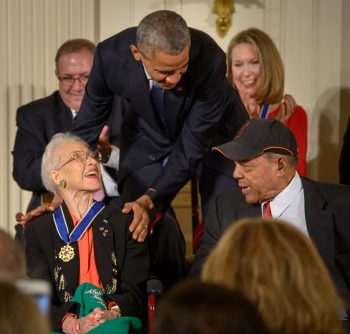
In 2015, at the age of 97 Katherine’s work was finally recognized nationally with honors from the first African American President, Barack Obama. He thanked her for her immeasurable contributions to the NASA space program and awarded her with the highest presidential honor bestowed to a civilian, the Presidential Medal of Freedom. Johnson passed away on February 24, 2020, at 101 years old. Today we honor her memory, her passion for science, her hard work and dedication, and her contributions which propelled humanity and America forward.
 E. Willa Simpson is an artificial intelligence scientist, researcher and freelance journalist. Her writings cover key issues and special topics related to A.I., social sciences, history, climate change, epidemiology and social memory of pandemics, world economic system and other topics. Simpson’s writings are part of the literature collections of Harvard, Yale, Johns Hopkins University, the National Library of Rome, Museum d’ Ethnographie de Geneve, United Nations and the Nobel Prize Museum. Simpson has also received the honorary distinction of Who’s Who in America 2025.