

In an era where sustainability stands at the forefront of innovation, 3D printing (3DP) has emerged as a game-changing technology, reshaping industries while playing a pivotal role in improving efficiency and driving sustainability. From reducing waste to optimizing designs and revolutionizing production methods, 3DP now shapes the future of manufacturing.
When we refer to 3DP, we mean the construction of a three-dimensional object, layer by layer, from a computer-aided design or a digital 3D model. This innovation, also referred to as additive manufacturing, first came to light in the 1980s when engineers sought to develop a rapid prototyping system. Since then, 3DP has evolved at an astounding rate, fueled by advancements in material innovation, artificial intelligence, and automation. As 3DP continues to expand its influence, it presents a wide range of opportunities to integrate sustainability into manufacturing processes.
Waste Reduction
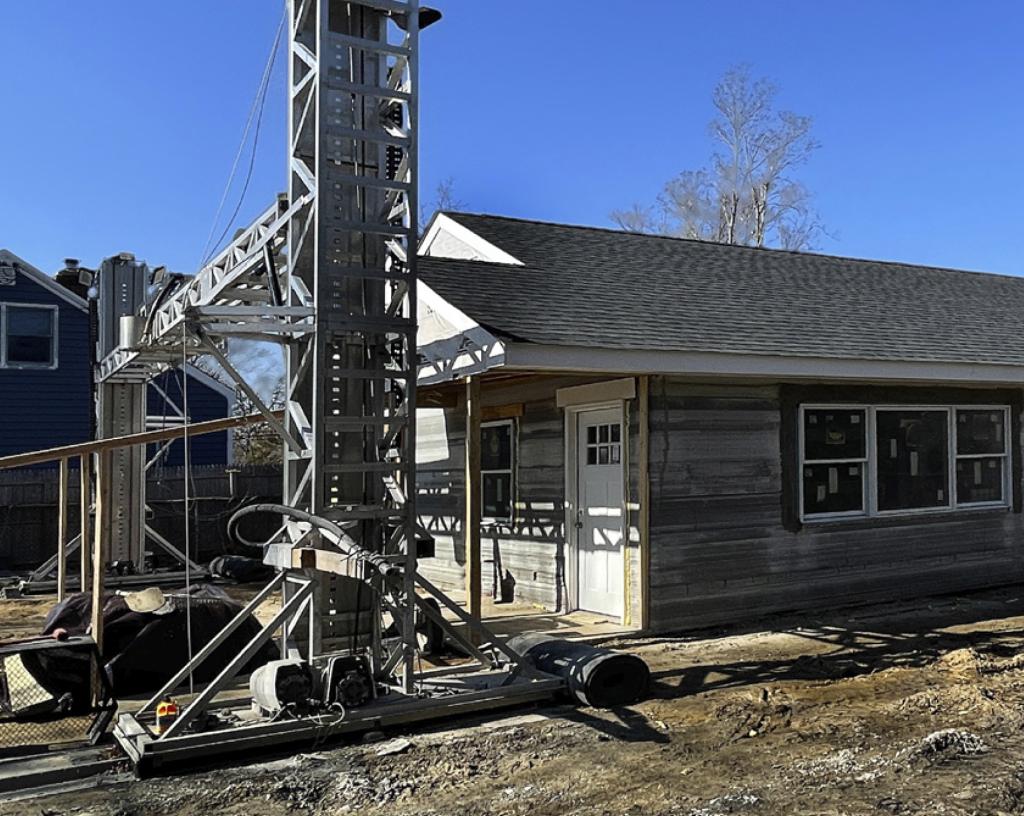
One of the most significant advantages of 3DP lies in its ability to drastically reduce waste. Unlike such traditional approaches as machining and molding, which have to carve off and thrown away excess material, 3DP builds layers by using just the materials needed to shape the final product. This approach generates up to 90% less scrap material, making it a more sustainable option for many industries.
Additionally, 3DP can integrate recycled materials, which further decreases waste accumulation and enables industries to work toward near-zero carbon footprints in their production processes. In the construction industry, for example, 3D concrete printing has proven to be a game changer for sustainability. Studies show that this approach reduces material waste in the construction industry by up to 90%, revolutionizing sustainable building practices.
ICON, a construction technology company, leverages 3DP to build homes and has reported a 60% reduction in material waste. In aerospace, the benefits of 3DP prove equally impactful with virtually no waste recorded during production. Moreover, the industry creates lighter and stronger parts with 3DP, which lead to increased fuel savings and reduced emissions. Boeing, for example, now replaces traditional metal components with lightweight, high-strength polymer and titanium parts on its 787 Dreamliner. This shift to 3DP has helped Being to achieve a 50%-reduction in waste compared to conventional manufacturing methods, as well as to enhance the overall performance of the aircraft. However, 3DP’s potential for waste reduction and sustainability extends far beyond just saving materials—it represents a fundamental shift toward more efficient, eco-friendly production across industries.
Revolutionizing Production
Unlike traditional methods, 3DP offers a key advantage: It facilitates unmatched design capability through customization and on-demand production, even for complex designs. This capability has revolutionized how industries cater to individual needs and specific applications, enabling them to engage in faster production without the need for expensive tooling or mass manufacturing. As a result, companies no longer feel constrained by the limitations of traditional manufacturing processes and can produce tailored solutions with great flexibility and efficiency.

Several innovative companies that now capitalize on these benefits tout notable success stories. General Electric (GE) uses 3DP to produce lighter and stronger aircraft engine components—for instance, fuel nozzles— with significantly less material wastage. Similarly, IKEA leverages 3DP to minimize overproduction and to incorporate recycled materials into their production processes, thereby reducing the environmental impact of excess inventory. Another example, Adidas, points to the use of 3DP to develop its Futurecraft 4D line of shoes—high performance, durable footwear with little environmental impact. In the energy sector, Siemens integrates 3DP into turbine production, which allows them to manufacture replacement parts on demand and to reduce the need for large inventories and excessive amounts of raw materials. Ultimately, 3DP’s ability to streamline production while promoting sustainable practices now transforms industries, empowering them to adopt more sustainable practices and to reduce waste, all while maintaining high-quality, customized outputs.
Optimizing Designs
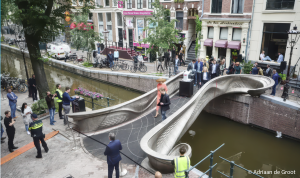
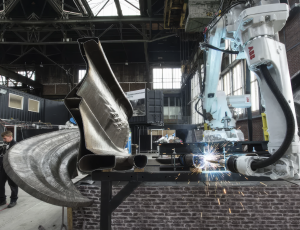
In addition to reducing waste, 3DP clearly offers designers a unique opportunity to push creative and technical boundaries, enabling them to produce designs that they once deemed too complex or actually impossible to create. Bugatti, for example, leverages 3DP for its brake caliper, now known as one of the most powerful in the automotive world. Meanwhile, General Motors utilizes generative design tools to produce a seat bracket that helps the company to achieve significant weight savings and to demonstrate the potential of optimized, lightweight designs. One of the most impressive 3DP designs, Amsterdam’s MX3D pedestrian bridge, truly stands out at 12 meters in length, printed entirely in metal, and fully functional since 2021.
Additionally, in health care, 3DP currently revolutionizes the creation of prosthetic limbs and other body parts, transforming lives and care options. The scope of 3DP’s impact seems vast, and these examples only scratch the surface.
As the capabilities of 3DP continue to evolve, so does the innovation potential. The technology now encompasses a wide range of techniques, each offering unique advantages. Some manufacturers, for instance, use fused deposition modeling to print with plastics, while others use digital light processing to cure photopolymer resin in order to create high resolution parts. Still others take advantage of bio printing (which relies on biological materials) for a variety of medical applications, and some companies use selective laser sintering and stereolithography techniques, both of which rely on laser or light, to cure materials, create smooth, durable finishes and enable precise, complex designs. These methods represent only a few examples of how 3DP unlocks new dimensions of possibility, continually expanding the space for innovation.
What’s Next?
Clearly, 3DP has already made a significant contribution to advancing sustainability, yet its full potential remains largely untapped. As the technology evolves and materials continue to improve, the opportunities for design optimization, waste reduction and revolutionized production continue to expand even further. Analysts expect the additive manufacturing market to experience substantial growth in the coming years, with revenues projected to reach $88 billion by 2030. This growth will undoubtedly open doors to addressing more sustainability challenges across industries
Advancements could enable designers and manufacturers to use recycled materials much more robustly and to take advantage of such eco-friendly building materials as clay and hemp to create sustainable structures. In health care, 3DP could reduce risks from synthetic implants by producing biodegradable, patient-specific solutions. Additionally, 3DP could be instrumental in creating advanced filtration systems designed to remove pollutants from water or to transform ocean waste into new products and materials.
The fashion industry could also benefit greatly by using 3DP in zero-waste clothing production and in the creation of tailor-made garments without fabric waste. In the realm of consumer goods, it could enable on-demand production of replacement parts, extending the life cycle of household items and significantly reducing waste. These possibilities paint a compelling picture of a sustainable future, where 3DP serves not just as a tool for innovation but also as a transformative force for the environment.
Three-dimensional printing provides a dynamic solution for many of our sustainability challenges, offering us a clear path toward a future that centers on efficiency, innovation and environmental responsibility. Companies like GE, IKEA, Adidas, and Siemens have already demonstrated the transformative potential of 3DP, proving that sustainability and advanced manufacturing can go hand in hand. With industry pioneers such as Statasys, 3D Systems, and Desktop Metal also pushing the boundaries of this technology, we stand on the cusp of a revolution that will significantly reduce waste, optimize resources, and transform industries.
By adopting this transformative technology into our work, advocating for sustainable practices, and adopting ecofriendly materials and production methods, we drive the shift toward a more sustainable, circular economy. Together we hold the ability to shape the future of 3DP, ensuring that it not only serves our needs but that it also protects the planet and generations to come.
 Tabitha Wakhungu, a seasoned mechanical engineer, has a passion for innovation and precision. With extensive experience in design and analysis, she specializes in creating solutions that drive efficiency and functionality. Wakhungu is enthusiastic about leveraging technical and analytical skills to secure modern systems.
This article was originally published in AWIS Magazine. Join AWIS to access the full issue of AWIS Magazine and more member benefits.