
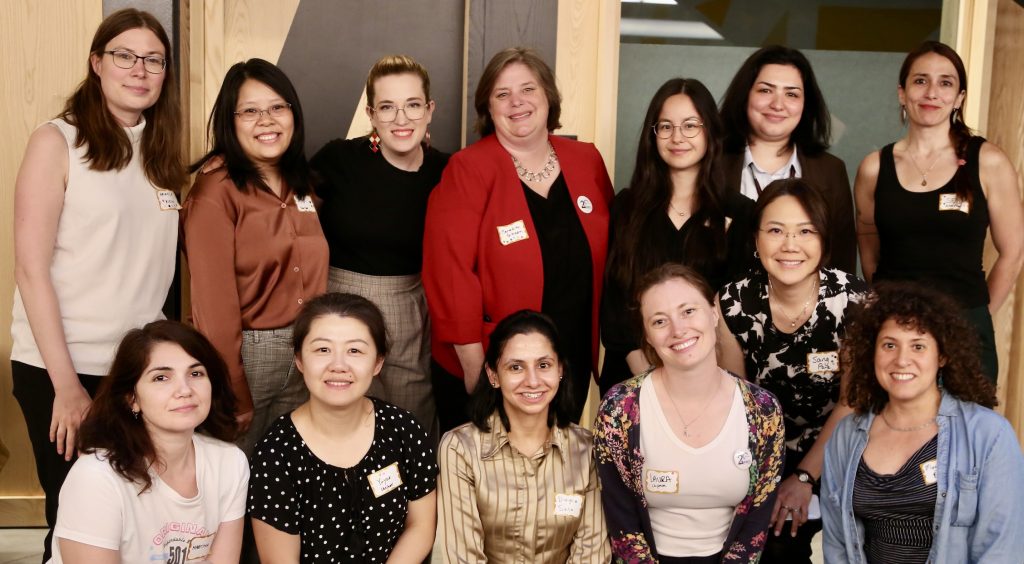
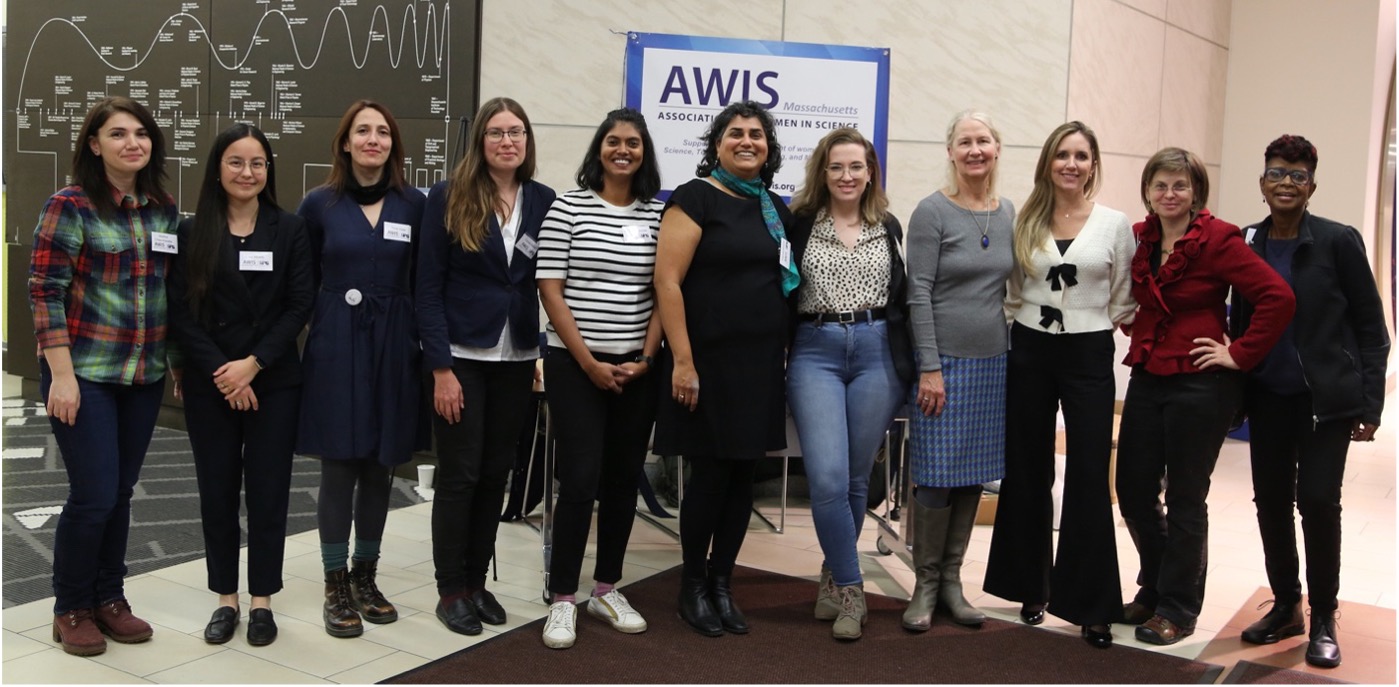
Photo credit: Deborah Karson
This year the Massachusetts (Boston) chapter of the Association for Women in Science (MASS-AWIS) celebrates its 20th anniversary. The chapter’s celebratory event was held at the Cambridge Foundry on June 11th, with a notable Leadership Discussion Panel including Meredith Gibson (AWIS CEO), Joanne Kamens (MASS-AWIS Founder), Angeliki Rigos and Tooba Cheema (Past MASS-AWIS Presidents), and Yael Zigelman (current MASS-AWIS President), who shared their stories and insights on how they shaped the MASS-AWIS landscape over the years. Following the chapter’s short-lived establishment in the 1980s and its permanent formation in 2004, MASS-AWIS has dedicated itself to promoting the advancement of women in science, technology, engineering, mathematics, and medicine (STEMM) fields. Among the 26 AWIS chapters, MASS-AWIS is one that stands out for numerous pioneering efforts in advocacy and professional development, and it continues to lead the way.
Historical Background

Kristin O’Brien and geneticist Joanne Kamens, motivated by inequities that they had experienced in their own workplaces, decided to reestablish MASS-AWIS in 2004. Kamens recalls that she had “noticed microaggressions and was often asked to do administrative things despite being a senior scientist.” She knew that she had to do something about it, so she obtained contacts of national AWIS members who lived in Massachusetts, some who were members of the original MASS-AWIS chapter, others who had moved to Massachusetts and were previously involved in other AWIS chapters, sent out invitations, and held a small, intimate meeting in her own house. She knew that there was a gender gap in STEMM and envisioned the need for AWIS in her state. She reports that in the first meeting she organized, “about 20 women showed up, and some of those women are still involved in the chapter or are close to the chapter.” From these humble beginnings, the chapter has proactively sought to meet the evolving needs of women in STEMM fields.
Major Accomplishments of MASS-AWIS
Over the past two decades, MASS-AWIS has been a leading chapter in fulfilling AWIS’s mission of championing the interests of women in STEMM across all disciplines and employment sectors, working to ensure that women scientists can achieve their full potential. The chapter has steadily expanded its impact by organizing numerous events and spearheading meaningful programs and initiatives.
The Mentoring Circle Program represents one of its most impactful programs, one through which many individuals segue into MASS-AWIS membership. Founded by Kamens back in 2007, the program offers mentorship in small, intimate groups of four to six mentees and two mentors, who meet for ten 2-hour sessions. A committee reviews applications and forms groups of mentees who have similar professional interests and are in similar career stages to ensure that those participating in the program can make the most of it.
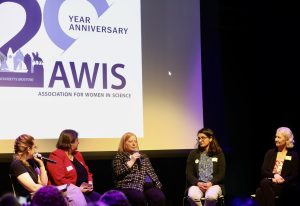 As Kamens says, “A lot of people get involved in the chapter through the mentoring and leadership programs. Those kinds of offerings create strength in the chapter by getting people involved and then by keeping them involved.” In the first year, STEMM career coach Sara Cardozo Duncan led the very first mentoring circle. In the second year, three groups formed, and in the fourth year, seven came together, with the number gradually increasing to 18 circles between 2011 and 2023. In 2019, just before the pandemic, the program had record-breaking participation with over 100 mentees.
The program’s incredible success highlights the necessity of mentoring women in science and creating a safe space where they can discuss challenges and seek advice. In a state like Massachusetts that has numerous research universities, as well as biopharmaceutical companies, the MASS-AWIS mentoring circle program has become an invaluable experience for many women, especially those who are seeking a transition in their STEMM career, such as from academia to industry. In addition, it was the first such program in any AWIS chapter, becoming a model that many other AWIS chapters have based their own mentoring programs on and setting standards for what a chapter can achieve.
Another program offered by MASS-AWIS is the Leadership Program. This program was envisioned by Dr. Angeliki Rigos and Dr. Cheryl Vaughan and supported by President Haifa Ghandour in 2018 to offer leadership development opportunities to help women in STEMM break the glass ceiling. The program initially focused on leadership development led by Drs. Rigos and Vaughan.
This program consisted of 8 two-hour workshops taught by a number of volunteers, including its founders. In the period 2019-2022, a total of 85 women participated in this program, many of them subsequently taking on leadership roles at MASS-AWIS, including our current president Yael Zigelman.
Feedback from graduates of the program made it clear that this type of training was empowering women in STEMM to take on leadership roles both at work and beyond. Dr. Rigos herself expanded her leadership workshops and began teaching leadership to graduate students and postdocs in the School of Science at MIT, and also founded Epistimi Inc., a nonprofit organization that offers leadership training to women in STEMM globally and began partnering with national AWIS.
In 2023, the Leadership Program evolved to cover entrepreneurship as the Innovation, Entrepreneurship, and Impact (IEI) Program in collaboration with Dr. Leila Deravi, co-founder and CTO at SeaspireSkincare and professor at Northeastern University. Currently, Drs. Deravi and Rigos have been hosting panel discussions on entrepreneurship and the special challenges faced by women in both the for-profit and nonprofit space. The ongoing goal is to reach more women entrepreneurs who can benefit from such a program in establishing and continuing their start-ups.
Both programs have been part of MASS-AWIS’ efforts to expanding the chapter’s impact of reaching gender equity in leadership positions as well as targeting unique entrepreneurial interests and needs of women in STEMM.
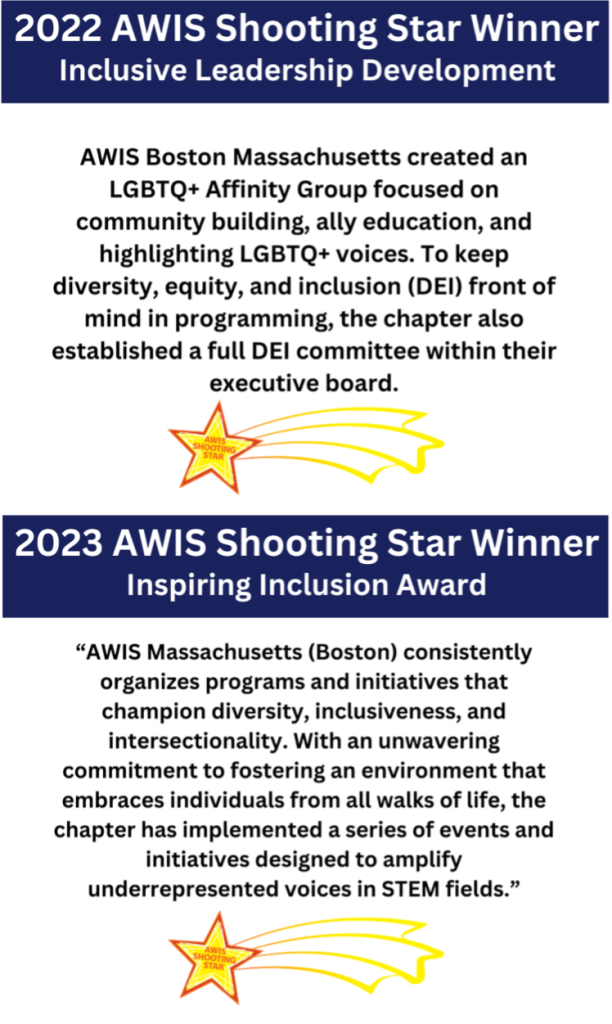 In more recent years, MASS-AWIS offered an LGBTQ+ virtual monthly meet-up to create a dialogue space for people with this intersectional identity. This eventually led to the formation of the first DEI committee among AWIS chapters. MASS-AWIS has focused on making the chapter more inclusive and on addressing how different identities play a role in one’s STEMM career. Its efforts have been recognized by AWIS National via the Shooting Star Chapter Award, which MASS-AWIS received two years in a row in 2022 and 2023.
Over the years MASS-AWIS has built a cumulative membership of nearly 450 who benefited from professional development and mentorship opportunities via the chapter, with 268 members who are currently active. In addition, there are approximately 2,000 subscribers to the biweekly MASS-AWIS newsletter, which contains updates on events and opportunities that the chapter offers and represents an important way in which MASS-AWIS stays connected with its audience in an increasingly digital era.
To coordinate and execute its mission, MASS-AWIS’s leadership has steadily increased in size. Starting with just five members on the board of directors (BoD) in the early years, MASS-AWIS has since expanded its BoD to include approximately 20 individuals and has developed increasingly specialized roles for these leaders. The current BoD includes the executive board (president, vice president, treasurer, administrator), as well as several committees (outreach and engagement; mentoring; communications; events; leadership; and diversity, equity, and inclusion), which ensure smooth operations of events and opportunities that MASS-AWIS presents to its audience.
MASS-AWIS’s programs and influential advocacy work have improved the professional lives of hundreds of women scientists within and outside Massachusetts while promoting gender equity. The numerous events and professional development programs have served to fulfill the organization’s mission, but according to Kamens, “The most important thing that AWIS has done is to create a support system for women.”
Challenges That MASS-AWIS Has Overcome
The success of MASS-AWIS may speak for itself, but just like every nonprofit organization, it is not immune to challenges and obstacles. Kamens emphasizes the importance of recruiting volunteers and filling leadership roles but also recognizes that while many individuals are interested in AWIS’s advocacy mission, fewer are willing to take active roles to keep it running: “Training for volunteerism and learning how to do succession planning are the biggest challenges, but we’ve never had a gap in leadership. Somebody’s always stepped in.”
The COVID-19 pandemic was a particularly difficult period for an organization that thrives with in-person networking. According to Yael Zigelman, current President and Vice President in those tough years, “AWIS is all about bringing people together, and when you take out that in-person aspect, you lose the magic of human connection. Virtual events also don’t require the expenses that usually come with in-person events, so we also lost a lot of our sponsors because that’s also based on personal relationships that were built for almost two decades and were kind of lost during those three years. So now we need to find new sponsors and build those partnerships, and that takes time, especially in today’s economy.”
Future Vision and Call for Action
MASS-AWIS has consistently demonstrated unwavering commitment and flexibility in adapting to the evolving needs of women in STEM. As MASS-AWIS recovers from the impact of the COVID-19 pandemic and continues its valuable mentorship, leadership development, and advocacy efforts, the current leaders look ahead to envision what more can be done for women in STEMM.
Zigelman, who will continue to serve as MASS-AWIS president in the 2024–2025 term, describes the importance of learning from each other’s unique experiences: “I think all women (and people in general) struggle, and even though the source of our struggles can be very different, struggle [itself] feels the same, and the way we overcome our challenges can also be similar, so we can all learn from each other. For example, I think that older generations can learn as much from younger generations as vice-versa. A support system is crucial to our success; no one reaches great achievements in a vacuum. It’s all about sharing experiences and supporting everyone across all walks of life and intersectionalities.”
MASS-AWIS founder Kamens calls for current and future members to continue the chapter’s legacy, emphasizing the invaluable experience of partaking in the committees that create events with such distinguished speakers and guests. “There’s a whole other level of experience and value in being part of a committee that creates events . . . that’s a more personal and intimate kind of experience and a stronger networking opportunity than just coming to an event and getting inspired.”
Kamens also invites more individuals to become allies and to support gender equity in STEMM fields. “Now, I always say it’s an association for women in science, not of women in science. Allyship is really important.”
 Erika Minetti is a researcher at Boston University School of Medicine, investigating vascular endothelial health in a translational setting. Her work delves into the impact of cardiometabolic diseases on vascular endothelial health, as well as the cardiovascular effects of using novel tobacco products. Minetti graduated from Boston University with a B.A. in Biochemistry and Molecular Biology and a minor in music performance, and an M.S. in Medical Sciences. She has been serving as the MASS-AWIS Communications Committee Co-Chair since 2023. In her free time, she plays the violin with the Harvard Griffin GSAS Student Center Orchestra and enjoys lifting at the gym.