
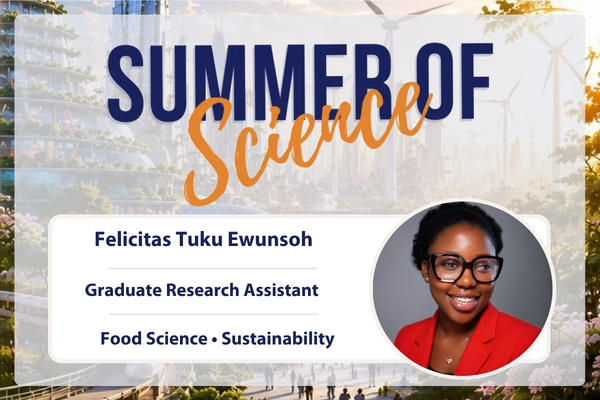
Felicitas Tuku Ewunsoh is a PhD student and Graduate Research Assistant at Purdue University, where she combines food science, engineering, and machine learning to improve the sustainability of food systems. Her research explores how agricultural byproducts can be transformed into nutritious, value-added ingredients through innovative processing techniques optimized with artificial intelligence. By reducing food waste while preserving valuable nutrients and functional properties, her work supports healthier foods, more efficient food production, and a more sustainable future.
A Day in the Life of a Graduate Research Assistant
What does a typical day in your role look like?
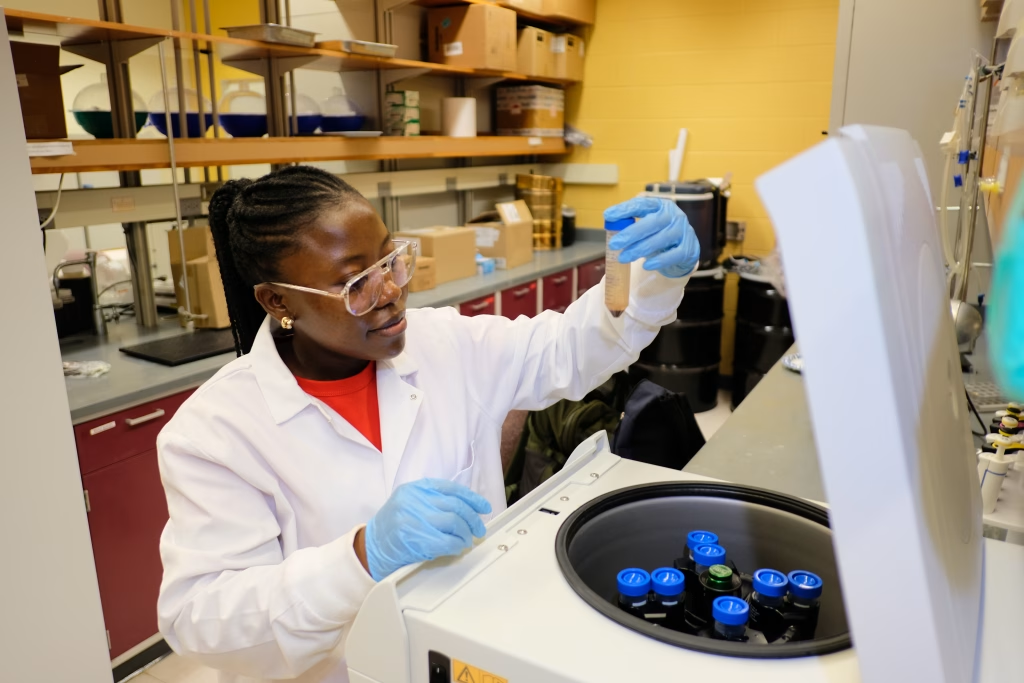
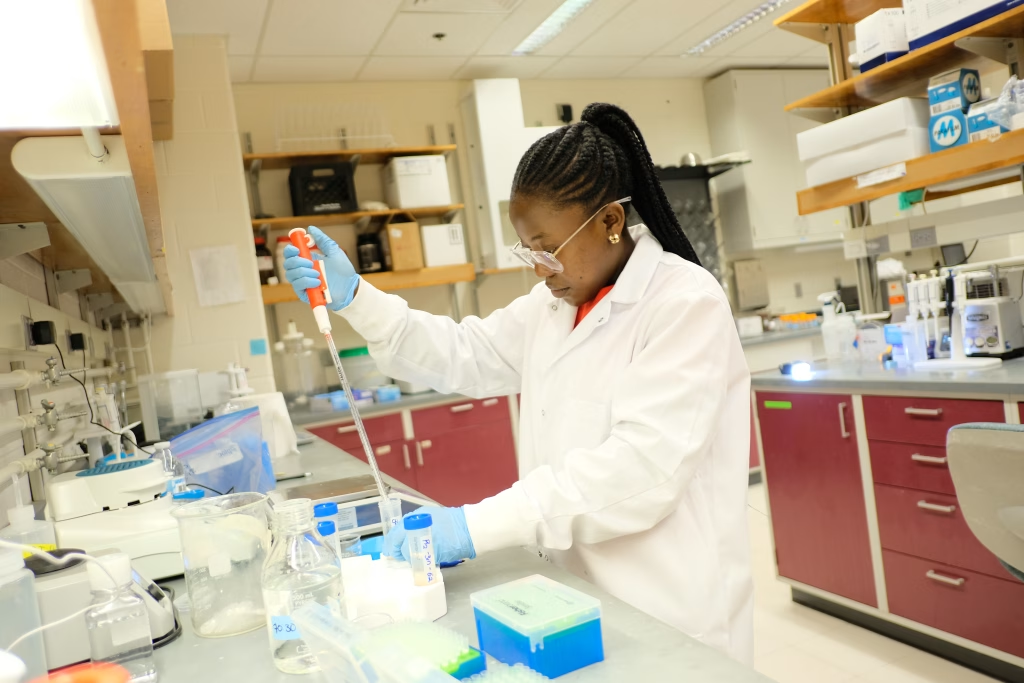
I am currently a PhD student and a graduate research assistant in the Product and Process Engineering Lab (PROPEL) at Purdue, where my work focuses on food processing, food safety, machine learning, and sustainability. My research explores how we can transform food byproducts such as grape pomace into valuable food ingredients while preserving nutrients, bioactive compounds, and fibre functionality using novel technology like radiofrequency. A typical day includes writing in the morning, then responding to emails/administrative work. Then get into the lab and do what I have to do; that way which most of the time it includes using the radiofrequency machine to dry samples, then analysis.
How would you explain your field of work to a kindergarten class?
I would say I study foods and how to make it safer, healthier, and less wasteful. Sometimes, parts of fruits and vegetables are thrown away even though they still have good things inside. My work is like being a food detective. I look closely at these leftover parts, find what is useful in them, and learn how we can turn them into something that can help make safer and healthier foods.
The Path to Food Science
During my undergraduate studies, I also participated in the Study of the U.S. Institutes exchange program, sponsored by the U.S. Department of State. That experience exposed me to entrepreneurship, leadership, and business idea development, and it helped me see how science can move beyond the laboratory into products, communities, and real-world solutions. I later earned my Master’s degree in Agricultural and Environmental Systems from North Carolina A&T State University, where my research focused on plant chemistry and crop protection. Before beginning my Ph.D., I also served as an adjunct faculty member at North Carolina A&T State University, teaching Plant Science. That experience strengthened my passion for teaching, mentoring, and helping students connect scientific concepts to real-world challenges. These experiences have led me to approach food science from multiple angles: from the farm, to processing, to safety, to sustainability, and ultimately to the people who depend on food systems every day.
I became interested in science because of chemistry experiments in high school, I was fascinated by how the chemicals changed color when acids or bases where added. Food Science particularly because of how closely food and health are connected. Food is not just something we eat; it affects public health, livelihoods, culture and sustainability. I am strongly guided by the belief that food is medicine, and I am working toward that idea every day through research that supports safer, healthier, and more sustainable foods. What keeps me motivated is the possibility of creating solutions that are both scientifically strong and socially meaningful. I am excited by research that takes something considered waste and turns it into value. The idea that food byproducts can become nutritious ingredients, that processing can be optimized to preserve quality, color, and bioactive compounds, and that machine learning can help us make smarter decisions in food systems continues to inspire me.
A lesser-known part of my work is that there is a lot of physics and engineering in food science, so there is a lot of troubleshooting, and you need to have a lot of patience because some days I spend time just trying to figure out what’s wrong with machines. Also, there is a lot of grinding, sieving, and weighing samples; some days that’s all I do before any actual analysis.
My proudest achievements so far has been using science, leadership, and mentorship to empower others. I am especially proud of mentoring young researchers through programs such as Purdue 4-H and the ASRI summer research program. Seeing students move from a project idea to collecting data, learning laboratory skills, interpreting results, and gaining confidence in themselves as young scientists is always a meaningful moment for me. Another achievement I value deeply is serving as Chair of the IFT Developing Solutions for Developing Countries competition, where students from around the world develop innovative ideas to address food security challenges in their respective countries. That role allowed me to support global student innovation and reminded me that food science can be a powerful tool for solving real community problems. Finally, I am proud of developing my current research proposal, which brings together food science, sustainability, machine learning, and human health. I wanted to bridge artificial intelligence and food systems while responding to some of the major challenges facing our environment and public health today. For me, this work reflects the kind of scientist I hope to be: someone who uses research not only to generate knowledge, but also to create practical solutions that help people.
The Science That Moves Us Forward
How has AWIS helped you professionally/or personally?
AWIS has helped me feel connected to a broader community of women in science who are leading, innovating, mentoring, and making an impact across many fields. As a woman in STEM, it is encouraging to see an organization that not only celebrates scientific excellence but also recognizes the importance of visibility, advocacy, mentorship, and belonging. Professionally, AWIS provides a space where I can learn from the journeys of other women scientists, reflect on my own path, and continue developing the confidence to share my work with more people.
How has your work/research helped drive discovery, innovation, or impact?
My research contributes to discovery and innovation by exploring how emerging food processing technologies and machine learning can support more sustainable and health-focused food systems. In my current dissertation work, I study radiofrequency drying of grape pomace, a byproduct of juice and wine processing, to better understand how processing conditions affect moisture removal, nutrient retention, bioactive compound preservation, fiber functionality, and color quality. Color is an important component of this work because grape pomace contains natural pigments that may have potential applications as food colorants. As the food industry continues to seek alternatives to synthetic colorants, understanding how drying novel processing influences color stability can help determine whether grape pomace colorants are not only safe, stable, and nutritious, but also suitable for real food product applications. This study is important because grape pomace is often underutilized, even though it contains valuable fiber, phytochemicals, and natural pigments. By developing optimized drying approaches and predictive models, my research can help transform this byproduct into a stable, functional, and value-added ingredient for food applications. More broadly, my work supports the circular economy by reducing food processing waste, preserving useful compounds, and helping the food industry make more data-driven decisions.
Where do you see your work heading next?
I see my work continuing at the intersection of food processing, sustainability, food safety, product development, and data-driven innovation. In the next phase of my research, I hope to further develop predictive models that can help optimize processing conditions for food byproducts and functional ingredients. I am also interested in studying how these ingredients perform in real food systems, such as improving texture, stability, nutrition, color, or antioxidant properties. Long-term, I am optimistic about developing healthy food products that support people’s well-being. I want my research to move beyond the laboratory and contribute to practical food solutions that are safe, nutritious, sustainable, and acceptable to consumers. I also want to continue mentoring students and communicating science in ways that make food science more visible, accessible, and impactful.
How do you see your work helping shape the future of STEM?
I see my work helping shape the future of STEM by showing how interdisciplinary science can solve complex problems. Food insecurity cannot be addressed by one field alone. They require food science, engineering, microbiology, chemistry, agriculture, data science and product development. By combining food processing with machine learning, my research reflects where STEM is heading toward more integrated, predictive, and solution-oriented approaches. I also hope my journey helps expand representation in STEM by encouraging young women, international students, and students from underrepresented backgrounds to see themselves as scientists, innovators, and leaders. Mentorship is a major part of that future for me because I believe that opening doors for other students is one of the most meaningful ways science moves forward.
To a Future Scientist Just Starting Out
What advice would you give to your younger self / someone just starting out in your field?
I would tell my younger self to stay curious, be patient with the process, and not be afraid when the path changes. I originally imagined myself in chemical engineering, but a scholarship opportunity led me into agriculture and food science, and that decision became one of the greatest blessings of my life. Sometimes the unexpected path is the one that reveals your purpose. If you are just starting, please know that “Not knowing something” is not a limitation; it is part of your strength. Your past experiences, communities, and challenges that shaped you can give you a unique perspective as a scientist. Use that perspective to ask meaningful questions.
What are some strategies you use to maintain resilience and persistence in the face of obstacles?
One of the main strategies I use to maintain resilience is keeping my eyes on the person I am becoming and the bigger purpose of my work. When obstacles come, I remind myself of where I started, how far I have come, and the responsibility I feel to keep showing younger students and future scientists that it is possible. My faith in God is also central to my resilience. It keeps me grounded, hopeful, and willing to keep going even when things are difficult. I also draw strength from my mother, who raised six children on her own after my father passed away when I was just nine years old. Watching her persevere through hardship, work hard, and continue to provide for us taught me that challenges do not have to define what we can become. In research, this mindset helps me keep going when experiments do not work, when data are unclear, or when I have to repeat an entire batch.
What message would you share with future scientists about the power they hold to make a difference?
I would tell future scientists that science is not only about discovery; it is also about service. So don’t be afraid to try. Also know that you do not have to wait until you are an expert to make a difference. You can make a difference by being curious, ethical, collaborative, and committed to learning. Whether you are working in a lab, classroom, field, company, or community, your ideas have the power to improve lives, protect the environment, and move society forward. The future of STEM needs your voice, your creativity, and your courage.
