
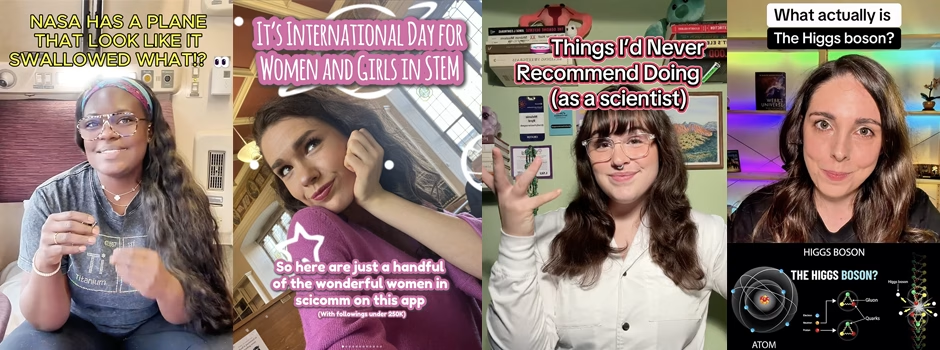
We no longer confine science communication to journals, conferences, or press releases. Increasingly, we offer it in sixty-second videos, comment threads, livestreams, and visual explainers. Many audiences, especially younger ones, now first encounter scientific discovery on social media platforms, where it can positively shape their understanding.
 According to engineer Chloe Lipton (@everydaysteminist), “Views are abstract. Algorithms are abstract. But realizing someone might feel more confident asking questions because of something you explained differently—that’s when it stopped feeling like content creation and started feeling like responsibility.”
Pandora Dewan (@ pandoradewan), a science writer, communicator, and editor, measures the impact of her words not in analytics dashboards but in messages from followers: “For me, it’s every time someone messages me to say that they decided to pursue a science degree because of my posts … that’s when it really matters, not likes and shares (although those are nice too).”
Public trust in science, in fact, increasingly intersects with digital spaces. The Pew Research Center reports broadly that more than 50 percent of US adults get at least some news from social media platforms, and this includes information about science.
As Dewan puts it, “If we want to encourage more people to pursue science careers, we need to excite them about science at a young age … [and now] they’re on social media.”
Science influencers certainly do not replace scholars. They instead respond to communication gaps by translating, contextualizing, and humanizing research in spaces where audiences already gather.
Many of the scientists working in these spaces, however, actually resist the science influencer label.
“I tend to call myself a science content creator because that’s what I do: I create content, both for social media and as a journalist. I’m not trying to influence anyone, I just want to make people excited about science,” Dewan explains.
Lipton refers to the label with similar caution: “I’ve never been entirely comfortable with the word ‘influencer,’ mostly because I’m spectacularly bad at influencing anyone to buy anything.”
Science communicator Melanie Byrd (@mellythesciencegeek) offers a broader definition: “Science communication [involves] being a translator for those who don’t understand scientific jargon. It’s being an entertainer … It’s advocating for why science is important.”
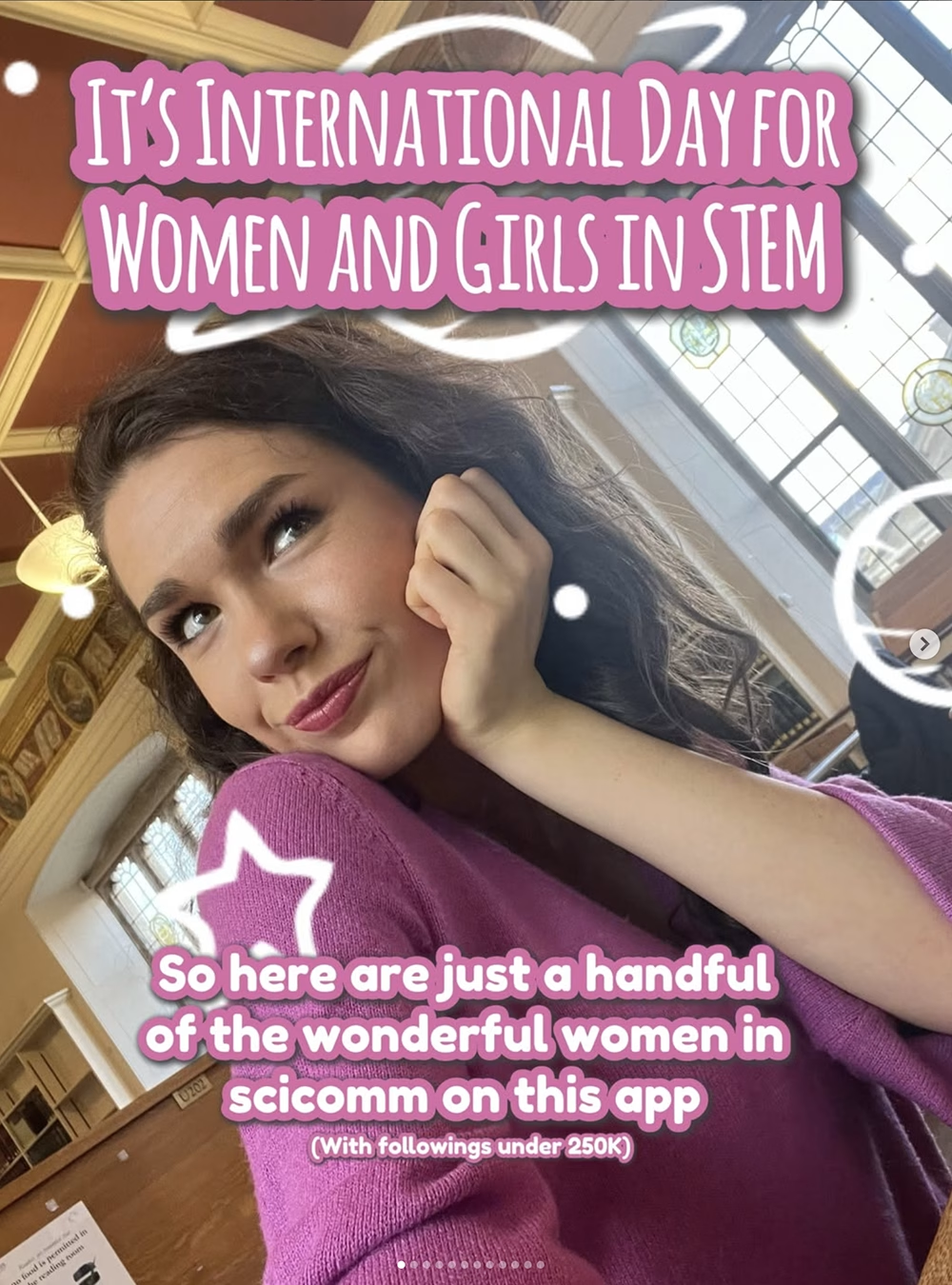 What distinguishes the work of science influencers from traditional outreach is platform choice, as well as structure. Academic communication often operates within institutional channels. Independent science creators use ecosystems that are shaped by algorithms, audience feedback, and rapid iteration. They function simultaneously as educators, personalities, and media producers.
Why Women Now Thrive in Digital Science
Digital platforms also alter power dynamics. Historically, women and marginalized scientists have faced underrepresentation as expert voices in mainstream media.
“Social media has changed science communication largely because it removes permission from the equation,” Lipton says. Online spaces allow scientists to bypass traditional gatekeepers and speak directly to audiences.
Byrd notes, “This newfound representation has shifted how people see scientists and even how they see themselves in science.” Research on STEM identity formation supports this observation. Exposure to diverse role models and mentors strengthens belonging and persistence among underrepresented students.
When women scientists share not only their research but also their personal trajectories, setbacks, and multidimensional identities, stereotypes begin to erode.
The effectiveness of these women influencers aligns with evidence-based communication principles. Narrative framing increases engagement and retention.
Lipton’s goal reflects this research: “My aim is always for someone to finish a video feeling smarter than when they started, not because I simplified the science beyond recognition but because they were invited into the thinking process.”
Building Trust as a Communicator
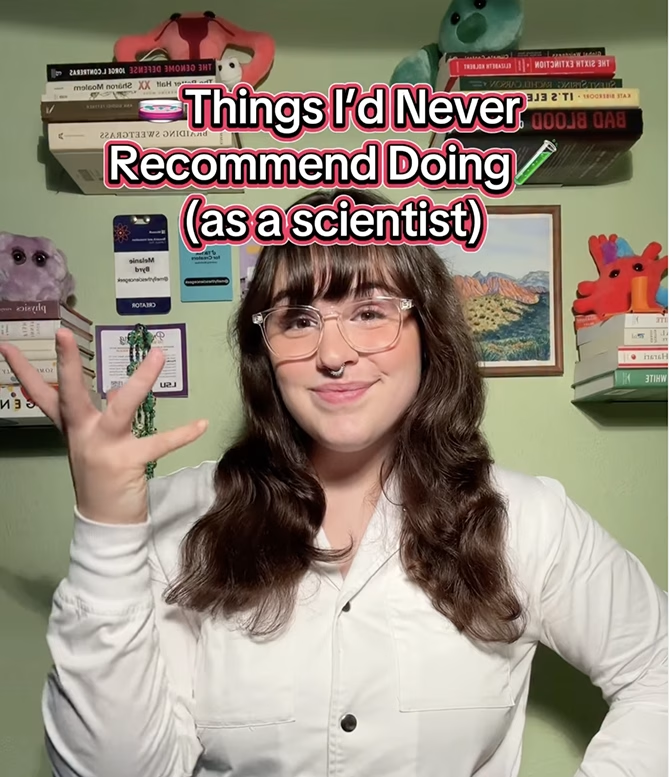 Social media influencers can’t build their audiences without representing themselves as trustworthy sources of information. Byrd explains that the key to building trust “is oddly very simple: You have to be transparent.”
Fellow science creator Dr. Raven Baxter (@raventhesciencemaven) emphasizes relatable tone over production polish: “My number one priority is to visually and conversationally make this feel like I’m talking to a friend versus me trying to compete with National Geographic and Bill Nye for production level.”
Studies on correcting misinformation in science communication suggest that open dialogue and respectful engagement increase receptivity. In digital spaces, credibility depends on relatability rather than on an institutional framework.
Having a friendly image and visibility also creates a kind of tension. On the one hand, a digital presence can create opportunity. Baxter notes that she has not typically applied for her professional roles as a scientist. “The jobs that I actually got are jobs that I was hired for because of my social media platform and because they understood me as a person.” Digital engagement also provides women scientists with the opportunity to better navigate the difficulties that could usually complicate their career trajectory. Dewan says, “It’s definitely helped me progress as a journalist because the industry is rapidly changing, and having a social media presence allows you to be more adaptable to the changing media landscape.”
On the other hand, as Byrd points out, “People think that you are no longer a scientist if you don’t work in a lab as your day job.” Some academic cultures still perceive public engagement as secondary to research output.
 Baxter challenges the narrow expectations about professional seriousness in social media: “My philosophy has always been: If we continue to play into this caricature of a scientist, we will never see a field that truly provides us space and opportunity for us to actually be ourselves and do things that are true to our goals and our dreams. We won’t ever get to a place where we have true community, where people learn to love and like you for you, no matter if they’ve had the opportunity to meet you professionally or personally or not.”
Indeed, Baxter frames a science communicator’s authenticity in a way that moves beyond self-promotion to the opportunity to target the masculine-dominated structures that have historically limited perceptions of women.
Despite this opportunity to challenge misconceptions, digital communicators do face emotional labor. Byrd explains, “What a lot of people don’t talk about with being a content creator is that you can never leave work.”
Research on digital labor identifies increased burnout risks among creators navigating constant visibility and engagement demands. Balancing scientific credibility, personal boundaries, and audience expectations requires ongoing negotiation.
Ethics and Responsibility
In addition to building a relatable and credible online presence, science communicators must consider the ethics of the role that they take on. Dewan says, “I think the responsibility of a science influencer is huge.”
Accuracy must remain foundational to anything produced. “When it comes to my content, the most important thing is that the information is accurate,” Byrd emphasizes.
Lipton reinforces the ethical stakes: “Science communicators don’t get to criticize misinformation while accidentally contributing to it ourselves.”
Misinformation research underscores the importance of clarity, repetition, and transparency in public correction efforts. Scientific rigor does not end at publication; it extends into the community for discussion and debate.
The Future of Science Influence
If digital public engagement is now central to scientific literacy, institutions must respond accordingly. The American Association of Universities has called for broader recognition of public engagement in academic evaluation.
Institutions can support science influencers by:
- providing media and digital communication training;
- recognizing outreach in promotion criteria;
- pairing researchers with experienced communicators; and
- integrating digital visibility into DEI initiatives.
Supporting visible scientists supports inclusive science.
We now see science influencers evolving toward engagement with micro-communities, niche expertise, cross-platform storytelling, and global participation in curating a change in education dynamics.
“If we all do this together, we can shift the culture forward in a way that’s way more welcoming than it is today,” Baxter says.
Lipton offers a reminder about pace: “Curiosity might begin quickly, but understanding deserves patience.”
The best content creators concentrate far more on providing access to scientific knowledge than on attaining fame for themselves. For many young audiences, the first scientist they encounter may be a creator who explains complex topics in a conversational way, rather than in an institutional format. Talented women influencers encourage wonderment and curiosity. In this way, their online presence becomes a form of real, if indirect, mentorship.
In social media, when someone feels welcomed into the thinking process, and when science feels accessible rather than distant, then that digital space can reshape their attitude and help them believe that they too belong on the cutting edge of science.
 Frances Tietje-Wang has a BS in biology and chemistry from Le Moyne College in Syracuse, NY. They founded Fermly, a data portal for craft brewers, in 2018 and became a TTB-certified brewing chemist that same year. Tietje-Wang works as a Cicerone Certified Beer Server, serves as a provisional Beer Judge Certification Program judge, and has earned their Brewing and Malting Science certificate from the Master Brewers Association of the Americas. They volunteer on both the MBAA DEI Committee and the American Society of Brewing Chemists Webinar Committee, and they teach as a subject matter expert in the MBAA Brewing and Malting Science Course. They speak on various subjects in the fermentation sciences and raise money for nonprofits that elevate marginalized communities in the brewing industry. They are a passionate hiker, runner, and rock climber in preparation for the zombie apocalypse.
This article was originally published in AWIS Magazine. Join AWIS to access the full issue of AWIS Magazine and more member benefits.