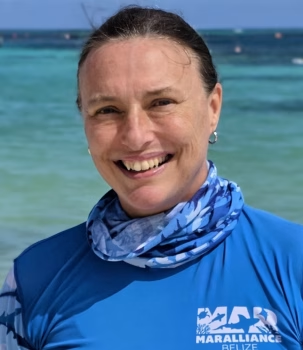
Dr. Rachel Graham

Making the Invisible Visible: Technology at the Frontier of Conservation

04/24/2026
By Rachel Graham, PhD

We can no longer treat the stability of marine ecosystems as an abstract concern. Their strength or fragility shapes food security, livelihoods, and the future of coastal communities worldwide.

Fisheries expansion where now over 90% of our fisheries are fully or overexploited, accelerating biodiversity and habitat loss continue to reshape the ocean, but many people continue to see these issues as distant or theoretical. This gap between reality and perception makes it difficult to build the human connections that motivate lasting conservation action.

Despite our deep dependence on marine wildlife—most obviously as food—we remain poorly educated about the vulnerabilities of many species stemming from their biologies, social lives, and the ecological roles they play. Conservation scientists strengthen our knowledge and awareness by teaching us about specific wildlife species and by urging us to protect these iconic animals. In this way, they can both safeguard the broader ecosystems that all life depends on and rekindle our sense of connection with the natural world.

My remit as Founder and Executive Director of MarAlliance, is to restore populations of a host of threatened and slow growing marine wildlife. I have spent three decades working to accomplish all this and created MarAlliance, a leading marine science and conservation organization locally grounded in several tropical countries to produce actionable scientific evidence that protects threatened species with the communities connected to them. Since 1998, I’ve been working with traditional fishers to create approaches to shark science and conservation that combine proven and emerging technologies with deep community engagement. Locally based work supersedes changing governments and policies to restore threatened marine wildlife populations while building the necessary connections between humans and wildlife that long-term sustainability requires. We believe in demand-driven, rigorous, and directly useful conservation, and they generate data that informs decisions, policy, and marine management at every level.

Restoring populations of such cryptic, long-lived, and late-maturing species as sharks, sea turtles, and large finfish demands multiple, overlapping tools: methods to detect presence and absence, assess species diversity and distribution, estimate population sizes, and track how these things shift with a changing climate. These tools prove most powerful when implemented in tandem with the communities who have the most at stake, including artisanal fishers whose livelihoods depend on healthy seas, tourism operators who need thriving wildlife populations, and governments obligated to meet international conservation commitments and foreign exchange thresholds for debt repayment.

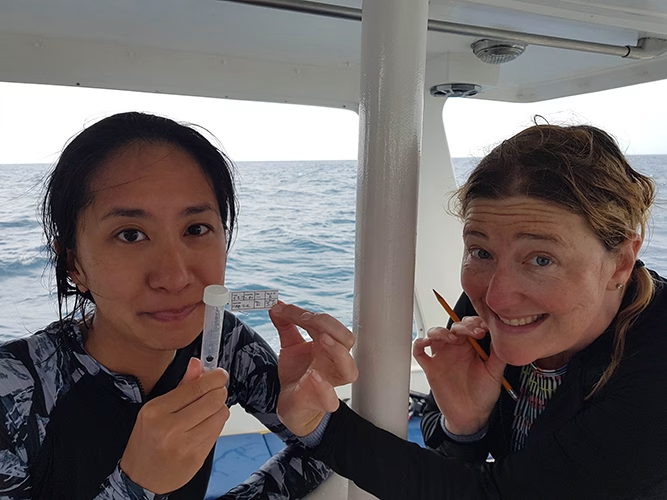
Rachel Graham collects water samples and filters for sawfish eDNA in the Darién region of Panama.
Rachel Graham collects water samples and filters for sawfish eDNA in the Darién region of Panama. Photo: Megan Chevis
Two Indigenous Embera fishers and newly minted Community Sawfish Investigators measure a juvenile critically endangered largetooth sawfish in Panama's remote Darien Gap.
Two Indigenous Embera fishers and newly minted Community Sawfish Investigators measure a juvenile critically endangered largetooth sawfish in Panama's remote Darien Gap. Photo: Megan Chevis
Rediscovering the Largetooth Sawfish Through Environmental DNA

Before conservation can begin, you first must know whether a species still exists. Few animals illustrate this challenge more vividly than the largetooth sawfish, a critically endangered ray that can reach seven meters in length and once populated tropical estuaries across the globe as a keystone, mid-level predator. Decades of incidental capture in fishing nets caused populations to collapse, and in most of its former range, the species has functionally disappeared.

For over two decades, MarAlliance has worked to document sawfish populations across Cuba, Belize, Honduras, and Panama. Traditional surveys provided fragments of information, but only Panama held confirmed sightings, in the vast, remote Darién region. That picture sharpened dramatically with environmental DNA (eDNA) analysis. By testing water samples for microscopic traces of genetic material shed by organisms, researchers can confirm a species’ presence without ever physically encountering the animal. A single water sample becomes a biodiversity snapshot of that place and moment.

In May 2021, the team documented the first scientifically confirmed capture and release of a sawfish in Central America in over two decades, a milestone that yielded critical biological measurements and genetic samples and demonstrated that recovery remains possible. Then, in 2025, the team identified the first largetooth sawfish nursery area in Panama’s remote and perilous Darien Gap region, a discovery with profound implications for conservation action and strategy. Environmental scientists now depend on eDNA for broader, regular monitoring of sawfish hotspots across the region, with the goal of finding adult populations and driving species restoration throughout the Americas.

Scientists released a Hawksbill turtle after fitting it with a satellite positiononly tag during an expedition in the waters of Lighthouse Reef Atoll, Belize.
Scientists released a Hawksbill turtle after fitting it with a satellite positiononly tag during an expedition in the waters of Lighthouse Reef Atoll, Belize. Photo: Pete Oxford
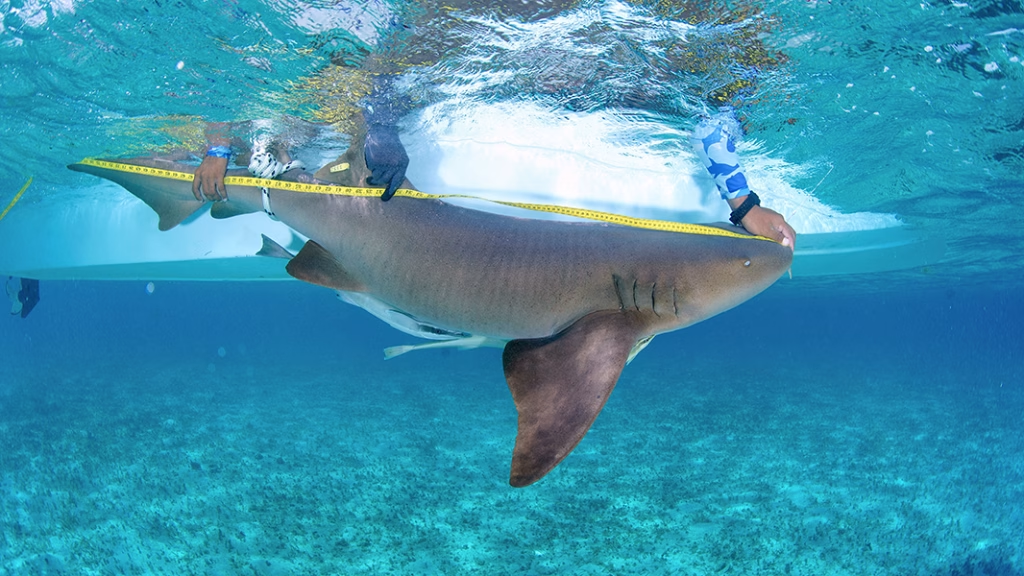
Measuring and conventional tagging of a nurse shark (Ginglymostoma cirratum) during an expedition in the waters of Lighthouse Reef Atoll, Belize.
Measuring and conventional tagging of a nurse shark (Ginglymostoma cirratum) during an expedition in the waters of Lighthouse Reef Atoll, Belize. Photo: Rachel Graham
Join MarAlliance in the Field

Field expeditions form the heart of the MarAlliance mission, offering participants a rare opportunity to work alongside Dr. Rachel Graham and her expert team in some of the world’s most remarkable marine environments, from the MesoAmerican Reef (MAR), the second largest in the world, to the biodiverse coasts of Panama. Expeditioners learn species identification and biology, research methods and to apply eDNA sampling, conventional, satellite and/or acoustic tagging, AI-assisted species identification, and citizen science protocols in real-world settings, contributing directly to ongoing co-created conservation research while exploring extraordinary ocean ecosystems. Find out how to join at maralliance.org/expeditions.

Revealing the Hidden Lives of Male Sea Turtles

MarAlliance also researches best practices in sea turtle conservation. Historically, sea turtle research has focused almost entirely on adult females, who return predictably to nesting beaches to lay eggs. Male sea turtles, by contrast, spend their entire lives at sea. Their movements, behaviours, and habitats have remained largely unknown—a significant blind spot, given that warming oceans already skew sea turtle sex ratios in favor of females: The warmer the sand in a sea turtle’s nest, the more female hatchlings emerge.

Satellite telemetry now fills that gap in research about male turtles. By tagging mature males—a logistical feat, as some individuals exceed 150 kilograms—MarAlliance has documented long-distance migrations between feeding grounds and mating areas that the team has come to call “love commutes.” Male loggerheads, it turns out, repeatedly travel specific offshore corridors on a structured, predictable schedule timed to the mating season. These are not random paths; they are dedicated highways.

The implications extend well beyond biology. Protecting nesting beaches alone cannot secure sea turtle populations if no one manages the offshore habitats that support reproduction. Satellite tracking makes the full life cycle visible, allowing conservation and local policy to follow the animal rather than stopping at the shoreline— or at national borders.

Tracking Wide-Ranging Predators

The same logic applies to sharks. Acoustic tagging, which uses networks of underwater receivers to detect tagged animals in coastal and reef systems, complements satellite tracking by capturing fine-scale habitat use alongside broad migratory patterns. Together, the two technologies reveal patterns of residency and movements across both local ecosystems and entire ocean basins.

A recent MarAlliance publication illustrates the scale involved for tiger sharks: A tagged female completed a round-trip journey from Cabo Verde to Brazil, covering nearly 18,000 kilometres in just over a year. Without satellite technology, scientists would never have detected the otherwise invisible migration. Emerging data provides hard evidence that ocean ecosystems connect across vast distances and that our conservation strategies must reflect that connectivity rather than treating national waters as isolated units. And these and other like findings are timely in light of the recent declaration of the High Seas Treaty that seeks such data sets to establish effective protective measures for highly mobile wildlife in what has long been considered seas with no owners, prey to a tragedy of the commons.

Remote sensing satellites add another layer of insight, monitoring sea surface temperature, chlorophyll concentrations, and ocean productivity to map wildlife habitat preferences and model how residence patterns and movements shift over time. These tools help evaluate the real-world effectiveness of such conservation measures as marine protected areas and seasonal fishing closures. AI and machine learning also increasingly help to process large movement and imagery datasets, accelerating the translation of raw data into decisions.

Digital platforms now also transform how communities participate in conservation. MarAlliance’s MARAP diary platform allows fishers, divers, and coastal residents to log sightings, strandings, and ecological events in standardized formats that feed directly into centralized scientific databases. This demand driven creation of this application and the broadly multi-sectoral participatory approach to testing builds trust, bridges the gap between researchers and ocean users, and ensures that local knowledge becomes embedded in formal science. MarAlliance also maintains a real-time tracking page on its website, giving the public a live view of satellite-tagged turtles and sharks, an open-access window into the lives of animals that most people will never encounter in person and a powerful tool for inspiring stewardship.

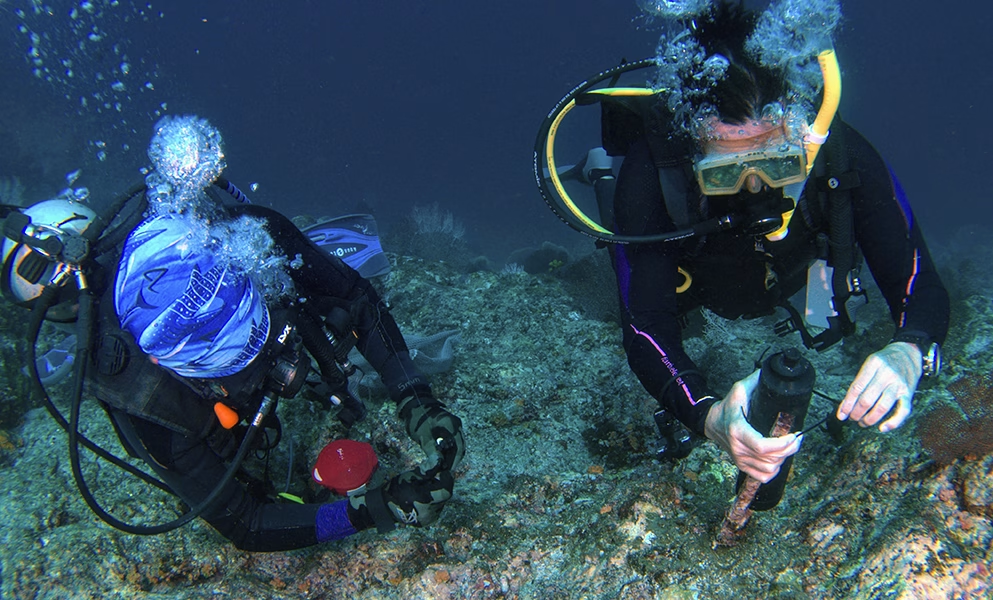
MarAlliance expeditioners in Cabo Verde collect samples of manta ray skin for subsequent genetic analysis of populations.
MarAlliance expeditioners in Cabo Verde collect samples of manta ray skin for subsequent genetic analysis of populations. Photo: Rachel Graham
My colleague Julie Berry and I install an acoustic receiver in Coiba National Park, Panama, to track several species of sharks and rays.
My colleague Julie Berry and I install an acoustic receiver in Coiba National Park, Panama, to track several species of sharks and rays. Photo: Megan Chevis
Toward Continuous, Data-Driven Conservation

The speed of environmental change requires more than periodic studies: It demands conservation that learns and adapts in real time. MarAlliance helps to make that shift possible by combining molecular analysis, advanced tracking technologies, predictive modeling, and community-driven monitoring to create a coherent, sustained approach to protecting marine wildlife.

Technology does not substitute for field experience or local stewardship. It can extend their reach and level the science “playing fields” between north and south. It reveals the presence of species too elusive to observe directly, maps migratory corridors spanning entire ocean basins, anticipates habitat change before it becomes irreversible, and anchors community observations within rigorous scientific frameworks. The result is a richer, inclusive and more dynamic picture of the ocean and its wildlife that we can all better connect with and steward more successfully.

Dr. Rachel Graham

Dr. Rachel Graham is a marine conservation scientist and founder of MarAlliance, working across 12 countries for over 30 years with small-scale fishers to protect marine wildlife. An IUCN Shark Specialist Group member, she has innovated research and secured conservation and policy wins and earned the 2011 Whitley Gold Award and 2021 Pew Marine Fellowship.

This article was originally published in AWIS Magazine. Join AWIS to access the full issue of AWIS Magazine and more member benefits.