
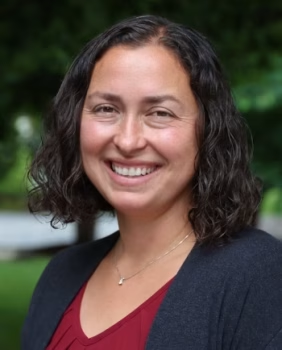
The cosmos has always inspired human imagination and serves as a boundless source of discovery. As an associate teaching professor at Drexel University and as Associate Director of DrexLab, Dr. Christina Love has committed herself to mentoring the next generation of scientists while she advances public understanding of the universe’s most elusive particles, including cosmic rays and neutrinos.
Her work bridges the frontiers of astroparticle research, innovative science education, and public engagement and specifically focuses on astroparticles that travel to Earth from distant sources both inside and outside our Milky Way galaxy. She believes that unlocking the mysteries of these particles may help physicists answer fundamental questions about the origins and evolution of the cosmos.
Dr. Love joined the IceCube Collaboration, an international group of more than 400 scientists who operate the IceCube Neutrino Observatory, a detector buried in the Antarctic ice. As part of this effort, she leads Name that Neutrino, a citizen science program that invites the public to analyze IceCube patterns from astrophysical particles.
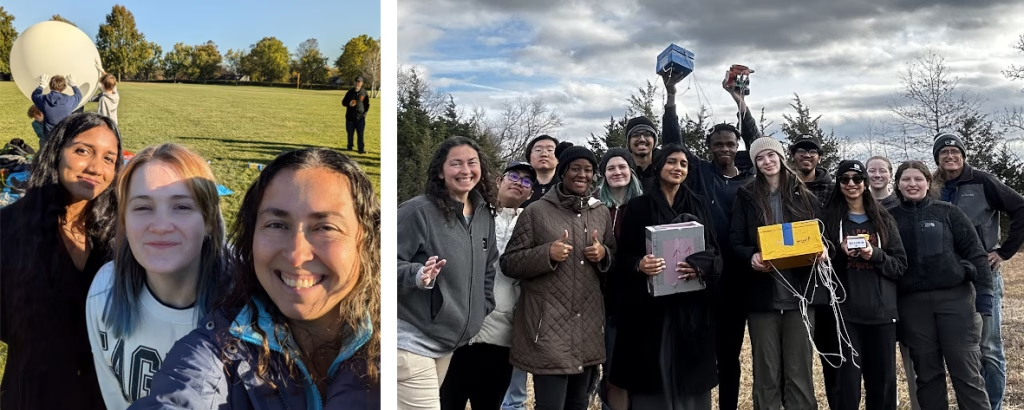
She also founded and leads the HighAltitude Engineering for Research in Astrophysics (HERA) Collaboration, a project that uses high-altitude ballooning to study cosmic rays— primarily protons that originate from high-energy astronomical sources. HERA fosters a multidisciplinary and international collaboration between high schools and institutes of higher education that aims to engage students in astrophysics research.
Dr. Love earned her PhD in physics from Temple University and her undergraduate degree from West Chester University in Pennsylvania. Later in her academic journey, she also made foundational contributions to national security technology during postdoctoral research at the Transportation Security Laboratory.
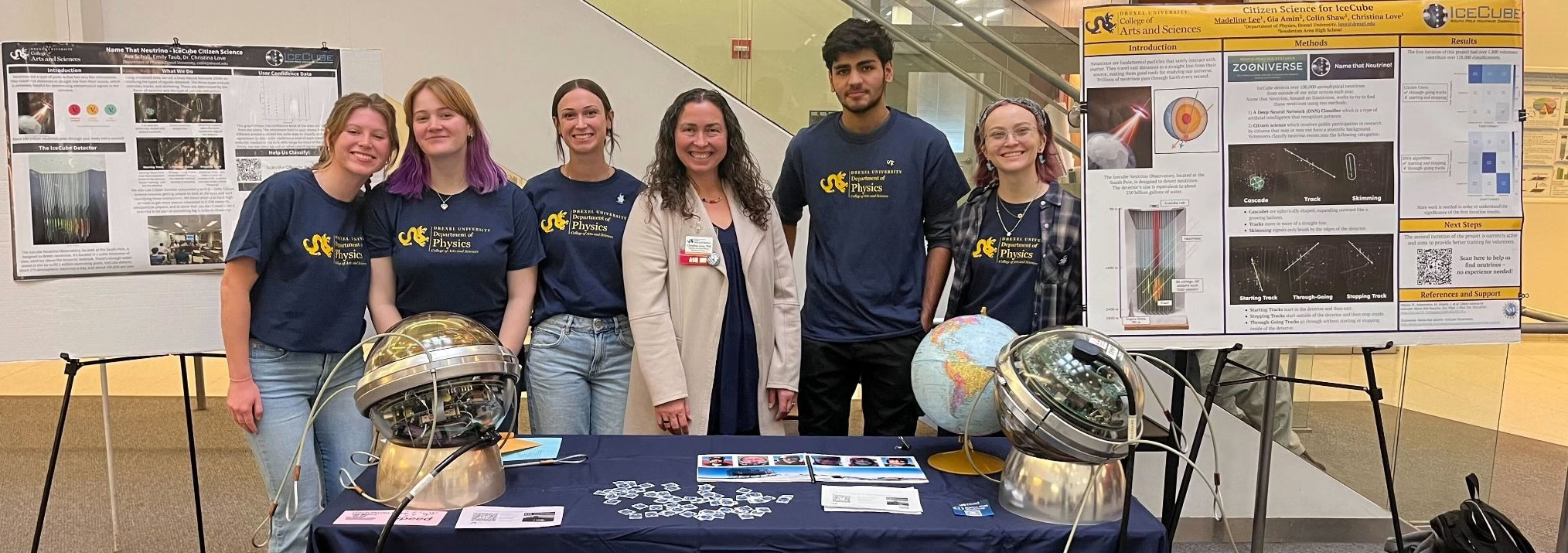
Beyond her research and academic contributions, Dr. Love advocates for science communication and equity in STEM. She founded and serves as the director of Start Talking Science, an annual public outreach event held at the Science History Institute in Philadelphia. This event helps scientists share their work with a broader audience in accessible and engaging ways. As a former president of the Philadelphia chapter of the Association for Women in Science (AWIS-PHL) and as a 2025 Emerging Scholar, she continues to represent and contribute to scientific communities.
I recently interviewed Dr. Love, who used the time with me to reflect on her educational and scientific career journey, her commitment to reshaping public perceptions of scientists, and her vision for a more inclusive and curiosity-driven future in STEM.
Can you share a pivotal moment from your early education that led to your interest in physics?
I have always been naturally curious about how things work. In high school, I gravitated toward mathematics and science and got interested in exploring scientific applications. Then I had the opportunity to attend a space camp. There, my peers and I became passionate about space exploration. That experience solidified my desire to pursue scientific research, particularly in physics and astronomy.
Did you have any mentors during your undergraduate studies, and if so, could you share how that mentorship shaped your journey in physics?
Ironically, I kind of had the opposite experience in physics as an undergraduate student. I wanted an undergraduate research opportunity, so I reached out to a professor. However, he continued to doubt that I would stay in physics and would not allow me to join his research group. I decided to use this experience as motivation to get through some of my most difficult courses.
Could you elaborate on the significance and mission of the IceCube experiment and on how it compares to the MicroBooNE neutrino experiment at Fermilab?
Neutrinos are invisible, electrically neutral, and nearly massless particles that rarely interact with matter. These unique properties make them powerful messengers for understanding the universe. The IceCube Neutrino Observatory (IceCube), located at the South Pole, is designed to detect high-energy neutrinos originating from cosmic sources, such as active galactic nuclei. It consists of thousands of light sensors embedded deep within the Antarctic ice. When a neutrino interacts with the ice, it produces high-energy secondary particles that emit Cherenkov radiation, which is a faint light that the sensors can detect. By analyzing the pattern and timing of this light, scientists can reconstruct the energy and direction of the incoming neutrino and the type of interaction. The IceCube’s mission is to open a new window into the universe through neutrino astronomy that allows high-energy neutrinos to tell us about the process that produced them.
The MicroBooNE experiment produces neutrinos in a controlled setting by using particle accelerators. It provides insights into the fundamental characteristics of neutrinos. Together, these two experiments will give us a more complete picture of neutrino physics. In general, neutrinos provide us with a different approach for looking at the universe.
Which current research initiatives excite you the most, and why?
I am currently working on a citizen science project for IceCube called Name that Neutrino. This initiative is a “win-win-win,” as it provides outreach for IceCube, enhances public engagement, and gives a new perspective on analyzing our data. Name that Neutrino is run on a web-based platform called Zooniverse, and it is available in seven languages. Motivated volunteers learn more about the research and perform visual analyses of data to identify different light patterns, leveraging our natural ability for pattern recognition. Additionally, I am excited about a project involving high-altitude ballooning in collaboration with a local high school. We launch particle detectors to measure cosmic-ray f lux, atmospheric temperature, and Earth’s magnetic field. We recently launched five balloons over 24 hours and in coordination with several other teams around the country.
What motivated you to establish Start Talking Science, a public event at the Science History Institute in Philadelphia, and what gaps in science communication were you aiming to address through this initiative?
As scientists, we often present our research to those with similar academic backgrounds, but communicating across disciplines can be challenging. During my time as president of AWIS-PHL, I frequently struggled to understand biologists because of their specialized jargon and my lack of biological knowledge. This experience made me reflect on how we, as scientists, could better communicate our work to those outside our disciplines and inspired me in 2014 to launch Start Talking Science, a free public event hosted by the Science History Institute. The goal is to help researchers share their work with a general audience, fostering understanding and trust in science. The event has received positive feedback, with many presenters returning annually.
What guidance would you offer those of us aspiring to pursue careers in physics or other STEM fields?
Support systems are essential, whether they consist of friends, classmates, mentors, or long-distance connections. Throughout my journey in STEM, these relationships have helped me stay motivated. I keep in touch with friends I met at space camp, even though we all have taken different paths. Some went to law school, some to aerospace engineering, but we continue to support each other.
I encourage you to join associations like AWIS that create spaces where women can connect, share experiences, and feel valued. Don’t be afraid to ask questions or to look for exactly what you want. While doing my PhD in physics, I wanted to try science writing, and so I googled science writing jobs in Philadelphia and found one. Interestingly, that experience led me to find the Science History Institute, which then eventually led me to partner with them on Start Talking Science. So, you never know where opportunities might come from; sometimes they even start with a simple question. So just ask and give it a try.
In your leadership role at AWIS-PHL, what strategies did you find to be the most effective in supporting early-career women?
One of the most effective strategies was the Mentoring Circle Program. I was part of the team that helped initiate this program in 2015, and it quickly became a meaningful space for early-career women to connect, share, and flourish. However, I also served as a mentor, and that experience was mutually beneficial. By sharing my personal challenges and some of my future goals during mentoring events, I helped to create an environment where others felt comfortable opening up, asking questions, and sharing their own experiences. Such mentoring events organized by AWIS-PHL fostered a supportive, collaborative atmosphere in which both mentors and mentees could learn from each other.
Another impactful initiative was the institutional partnership between Drexel University and AWIS. It lowered barriers to participation in AWIS events for our students. For example, Drexel waived membership fees for students and hosted on-campus events, making it easier for students, postdocs, and faculty to attend AWIS events. This type of institutional support is important since it fosters a culture of inclusion and also provides professional development opportunities within the university. AWIS has also played a vital role in supporting early-career women through scholarships and awards. Based on the success of the Mentoring Circle Program during my time as AWIS-PHL president, I strongly encourage other AWIS chapters to adopt similar programs. These initiatives make a real difference by expanding young women’s professional connections and boosting their confidence through positive reinforcement.
 Shruti Shrestha, PhD, is an Assistant Teaching Professor of Physics at Penn State Brandywine. Dr. Shrestha, a particle physicist, worked on the High Voltage Monolithic Active Pixel sensor for the Mu3e Experiment. She also conducts free workshops in the Philadelphia area to motivate and empower girls to pursue STEM degrees.
This article was originally published in AWIS Magazine. Join AWIS to access the full issue of AWIS Magazine and more member benefits.