
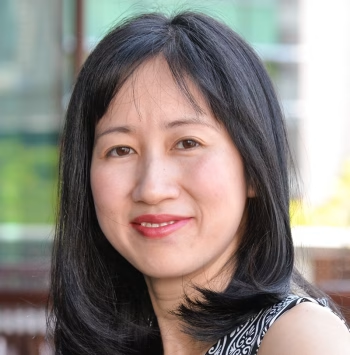
Professor Jing Jiang has built a career marked by extensive international experience. Previously a Professor and Director of the AI & Data Science Cluster in the School of Computing and Information Systems at the Singapore Management University, she is currently at the School of Computing at the Australian National University. She holds a PhD degree in Computer Science from the University of Illinois Urbana-Champaign and MS and BS degrees in Computer Science from Stanford University.
Her research interests span critical areas such as natural language processing, text mining, and machine learning, with a particular focus on the comprehensive evaluation of multimodal large language models (LLMs). Her team has conducted work evaluating multimodal LLMs (which combine text and images) for social biases. She addresses techniques for preventing bias while highlighting that addressing bias in AI is not solely a technical problem for Natural Language Processing (NLP) researchers; it requires a broader societal consensus on what constitutes “expected behavior” and “values” for these models, especially given diverse cultural norms.
Professor Jiang’s impactful work has been recognized with two test-of-time awards for the demonstrated significant, lasting impact of her contributions to social media analysis. In 2021, she was named one of Singapore’s 100 Women in Tech, an honor that underscores her significant influence and leadership as a woman in the technology sector.
What were some of the most significant challenges you faced when transitioning to an international scientific career, and how did you overcome them?
The main challenge would be to understand the culture in the new place and how people operate in terms of getting funding, recruiting graduate students, and establishing the balance between teaching and research.
In Singapore, people socialize very easily; I used to have lunch with my colleagues every day. In Australia, people will bring their own lunch, and oftentimes just have lunch alone or in the office; people socialize through different channels. I’ve been trying to find other opportunities to talk to people, like going to every school meeting, actively collaborating with colleagues, having weekly research meetings, and getting to know PhD students and other colleagues.
In Australia, there is a different mix of nationalities, cultures, and perspectives. Some students are culturally very respectful of senior people. Sometimes I have to encourage them to share more of their own thoughts, to push back on research ideas, and intentionally make them feel comfortable, so they don’t feel “This may offend people.” More senior people, professors, really treat the student as a peer, as a colleague. In an international setting, it’s even more important that everyone sees and understands that.
In the university where I am, a junior person will be assigned someone senior as a supervisor to provide career guidance. When I moved here, I was already a senior person. But through collaborations with people, I learned how they work, for example, how they recruit students, look for funding opportunities.
How has your international experience shaped your perspective on scientific collaboration, innovation, and gender diversity in STEM?
Because Singapore is relatively small, researchers naturally must go to international conferences every year. I would always meet people from all over the world. Establishing and maintaining relationships with other woman researchers in the field, which is oftentimes easier to establish because you share common interests, has helped my career development.
My field historically has been quite gender balanced, maybe because it was a good balance between the technical side and the linguistics side; there were proportionally more women researchers compared with other computational fields. There’s a conscious effort by the community to maintain gender balance. For example, when there are committees formed to manage peer reviews or conferences, the organizers always emphasize gender balance and intentionally try to look for qualified women researchers. The organization SG Women in Tech annually recognizes 100 women in tech across academia, industry, and different career stages.
In Singapore, a lot of women who have a full-time job get support by hiring domestic helpers. Having affordable, oftentimes subsidized childcare services is another important factor. Culturally they can also expect a lot of childcare support from grandparents. My own parents and in-laws helped us with raising our kids when they were young. Unfortunately, where affordable childcare is less accessible, like in Australia or the US, it might be harder for women to develop their careers when they have young kids. Although, in Australia, the government offers a childcare subsidy.
How has working outside the US opened career paths you hadn’t considered or couldn’t have pursued in the US?
Moving to Singapore gave me more opportunities to work with collaborators and graduate students from that region—from China, from Vietnam—which would have been harder if I were in the US. Because the US is so large and has so much research activity, I might only be collaborating with other people in different parts of the US.
What advice would you give to other women in science who are considering pursuing international opportunities, but may be hesitant or unsure where to start?
Depending on their own experience and cultural background, it may be easier to pick a place that you feel more connected to based on your own background. For instance, Singapore is a good starting point, as it is already very international. Most of the population speaks English, and culturally, it’s been influenced by both Asian culture and Western culture.
Wherever you go, apart from making new friends, also look for a community of people with similar backgrounds to help you to fit into the local community. For example, here in Australia, in Canberra, we know there is a Canberra Singapore Club; we joined that club so that we have opportunities to meet other Singaporeans living overseas.
If there are women interested in pursuing a PhD degree, or those who already have a PhD degree, and are thinking of growing their career outside of the US, I encourage them to explore Australia or Singapore, especially for those interested in my field of computing, machine learning, language technologies.
Read about other women who have explored a global pathway.
 Georgina To’a Salazar, PhD, works to create innovative solutions in science communication, research, and policy. With a BS in chemical engineering from Stanford University and a PhD in biomedical engineering from the University of California, Irvine, Dr. Salazar has fulfilled her dream of exploring the world, having taken research positions in Singapore and Japan before returning to the United States to focus on science communication. She currently works as a freelance scientific writer through her small business, Redwood Scientific Communications, LLC.