
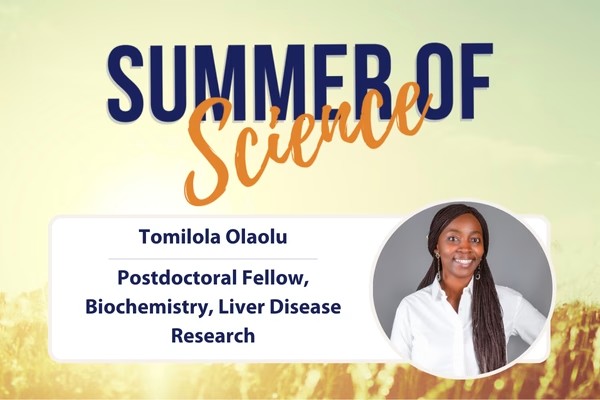
Dr. Tomilola Olaolu is a postdoctoral fellow at Tulane University dedicated to uncovering the molecular mechanisms behind alcoholic liver disease. Her work bridges laboratory research with real-world impact—combining hands-on experiments, data analysis, and scientific communication to better understand how liver damage occurs and how it can be prevented. Driven by a commitment to improving public health, she aims to translate her findings into targeted interventions that save lives.
A Day in the Lab
What does a typical day in your role look like?
A typical day as a postdoctoral fellow at Tulane university begins with monitoring the health of our research animals (mice), feeding them with alcohol and high fat diet, recording their bodyweights, strictly adhering to approved protocols. After this, I maintain hepatocyte cell cultures, challenge cells with ethanol at different time points and investigate DNA damage response and apoptosis in these cells, to model aspects of liver injury. I also perform different biochemical and molecular assays to evaluate liver damage and inflammation, including ELISA, western blotting, I also isolate RNA and perform qPCR for gen expression profiling.Furthermore, I routinely analyse data after collection, interpret results, prepare figures and make presentation of my result in our weekly general laboratory meeting. In all, my role integrates wet lab with critical thinking and scientific communication, resulting in a wider understanding of the mechanisms surrounding alcoholic liver disease. Summarily, every day involves hands-on laboratory work, data collection and analysis.

The Path to Water Science
I have a BSc, MSc and PhD in biochemistry. My background in Biochemistry prepared me for my role as a research scientist. I developed good research skills, wet laboratory skills, working with research animals, and carrying out different laboratory assays. I have also been able to design experiments, interpret results, and contribute to finding solutions that can protect human health.
I keep a colorful array of sticky notes at my workspace, each with motivational reminders and mini checklists, to help me refocus when I hit a roadblock. I also treat scientific writing as a form of storytelling, crafting narratives that bring data to life and engage diverse audiences.
One major strategy that I use is to stay focused on my purpose, remembering why I started this journey in Science in the first instance and the impact that I desire to make. I also believe in talking with mentors, who have walked in similar paths as me and can advise me appropriately.
Science with Impact
What is your proudest achievement in your career?
My proudest achievement is the opportunity I have had to mentor younger scientists and biochemists, I have been privileged to mentor some of them from their bachelors degree to masters and PhD degrees.
How has your work or research helped drive discovery, innovation, or impact?
My research has helped me to discover plants that are able to ameliorate the toxic effects of heavy metals. On my postdoc role, I am unraveling molecular mechanisms that surround alcoholic liver diseases, which would help to design targeted interventions or therapies for these liver disorders. Through my research, I’ve provided new scientific evidence that supports using certain medicinal plants to reduce damage caused by toxic exposures. This kind of work helps move science forward and offers new ideas for treatments, especially in areas where people face high environmental risks. My goal is to keep making discoveries that can improve public health and guide safer environmental practices.
The Power of Science and Community
What does the power of science and community mean to you?
To me, the power of science simply means the ability to study how things work and use what one has learnt, solving problems that result in making people’s lives better.
How has science shaped your sense of community—and how has community supported your journey?
Science has shaped my sense of community because I have come to realise that science is highly collaborative, especially when it has to do with research. I have had the opportunity to relate and work with different mentors, colleagues, and collaborators. This Science community, which also includes AWIS has helped me to keep learning and growing in my career.
To a Future Scientist Just Starting Out
What advice would you give to someone just starting out in your field?
I would advise them to seek mentors in Science and community of people who can guide and support them. I would also advise them to be resilient because there may be challenges, including failed experiments and rejections, but tough times never last, only tough people do.
What message would you share with future scientists about the power they hold to make a difference?
Your work/research has the potential to solve real world problems and bring hope to humanity. Therefore never underestimate the power of your curiosity and questions.
What would you tell your younger self?
I would tell my younger self something similar to what I’ll tell someone just starting out in my field… Seek mentors in Science and be resilient!