
Despite our efforts to gain equity, women faculty and leaders in academia remain underrepresented. According to the American Association of University Women, we make up the majority of nontenure-track lecturers and instructors across institutions of higher education but only 44% of tenure-track faculty and 36% of full professors. For women of color and those who are mothers, the odds of reaching the rank of full professor are even lower.
Graduate school, postdoctoral fellowships, tenure review, research publications, and other avenues for advancement in higher education often overlap with women’s childbearing years, limiting opportunities during these times if they coincide with parental responsibilities. Women tend to leave academia at higher rates than men and to experience work/life balance issues at a far higher frequency compared to male colleagues. Publication bias also exists: Women tend to publish less and receive less credit than male colleagues. Only 4.6% of Latina females make up tenured faculty at PhD-granting institutions. Adequate representation remains vital and a still-sought-after goal for women on the tenure track.
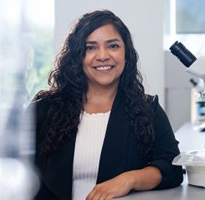
One Latina molecular biologist leads the way in walking the path to equal representation. Dr. Daniela Chávez is a reproductive biologist who recently completed her postdoctoral training as a Maryland PROMISE academy fellow at Towson University, where she has just transitioned into a tenure-track role as a Research Assistant Professor. Dr. Chávez is a Utah native with family roots in Mexico and Costa Rica. She began her undergraduate studies at Salt Lake Community College and later transferred to The Evergreen State College in Olympia, Washington, where she earned her BS. In 2018, she completed her PhD in the laboratory of Dr. Gillian Stanfield at the University of Utah, where she studied sperm development in C. elegans.
Dr. Chávez then began her postdoctoral training at Smithsonian’s National Zoo and Conservation Biology Institute in the laboratory of Dr. Pierre Comizzoli. There, she studied oocyte meiotic competence Alexander Wright | Towson University in the domestic cat as a model for improving assisted reproductive techniques in endangered wild cats. Now she continues her research on oocyte biology at Towson while teaching undergraduate and graduate-level courses. Throughout her career, she has also been heavily involved in diversity and inclusion efforts in the fields of reproductive biology and species conservation. In her new role, Dr. Chávez is looking forward to working at a primarily undergraduate institution that serves a majority-minority student body.
I interviewed Dr. Chavez recently about her journey, challenges, and goals and as a way to provide inspiration, insight, and information to other women taking on the tenure track.
Many young women face a set of societal and cultural expectations that influence their career decisions. Did you face any of these challenges growing up? What led you to pursue a career in genetics, cell, and molecular biology?
Absolutely! I was raised in the suburbs of Sandy, Utah. The societal and cultural expectations and norms at the time involved getting married right out of or soon after high school and having children, but I had no doubt that I wanted to study biology and was very set on doing so. I would certainly get asked questions, and people told me that I was weird in my early twenties when I didn’t do what most of my childhood and high school friends were doing. Family and friends were never rude about it, but I faced mental challenges in following a passion that is very difficult already and in hearing those voices of doubt about whether I was doing the right thing.
My upbringing also led me to pursue this career. I realize it is not common, but I have never wanted to be anything but a biologist. I think this is because I largely grew up in the mountains. We didn’t have a lot of money to vacation frequently, but we did go camping in the mountains regularly. From a very young age, I realized that I just wanted to be able to ask and know how to answer interesting questions about how life works.
What led you to academia?
What led me here was my love for preserving and conserving nature, mentoring students in the lab, and a passion for molecular biology, but ultimately, [what solidified my goals] was a fellowship opportunity. I did not have it in my mind at first to be in academia, mostly because I thought I might want to have children of my own one day, and I didn’t see myself making the sacrifices I saw most women making when they chose to have a family and to be an academic researcher. Before I knew of this opportunity, I was interviewing at biotech companies. In fact, I only applied to two academic positions.
What advice would you give other women exploring careers in academia? What advice would you give other women seeking tenure?
Ask other women for their honest opinion of how they like their jobs. I always tell my students to find people who currently have their dream job and to do informational interviews with them. I did this starting the year before graduating with my PhD. It was very illuminating and helped me eventually choose something I love, but this process takes time, so start early. As far as tenure advice, I think I am the one who needs it! I am approaching the tenure goal similarly to how I have approached the past decade of being in academic research, by attending workshops, seminars, and support groups for people in the same boat. I learned early in graduate school: Having a community of people with your same goals and current problems is priceless
In an interview with Towson University, a statement that you made stands out to me: “I pinch myself all the time thinking I’m starting my own research lab because I really didn’t think I was going to. I did not think that was going to be for me. I watched too many women struggle through it.” Can you expand on the struggles you have witnessed, stories you have heard, and challenges you have encountered during your career?
I said all that because at first, I just didn’t see how I would pursue a faculty position and have the family/ work life balance that is important to me. I am just very excited that I now have this opportunity and that I can keep doing the research I want to! In the casual informational interviews I did, I focused on asking women what it was like to have children and also to be in research, and I just got the sense that it was just incredibly hard. It seemed that most of them wished for more time with their own children or it sparked other challenges in other important relationships. While I wasn’t always sure I wanted to have my own children, I knew that if I did, they would come first, and I didn’t want to miss out on their young years for the sake of my career. What I didn’t have the opportunity to do [when I was researching next steps] was to interact with women who are not at R1 universities, which I think is just a much better fit for me and my goals. Don’t get me entirely wrong; most women seemed deeply intellectually fulfilled and talked about loving their jobs. They just seemed to be making some sacrifices that caused me to pause and be unwilling to commit to that road [and to working at an R1 institution].
You have long been committed to diversity and inclusion efforts in STEM. How did you contribute to these efforts in your fellowship, and how do you intend to do so in your new role as a tenure-track professor?
Thankfully, there are no additional expectations with my fellowship; that would be against the goal of the program to diversify the professoriate, if the program added expectations to underrepresented groups entering academic positions. I simply see my new role as similar to that of my colleagues: to be an outstanding mentor, scientist, and teacher. I plan to help increase diversity among faculty by bringing my whole self to the table with my unique perspective and by leaning into my experiences to empathize with, inspire, and motivate students navigating the complexity of mixing passions, family, humanity, and individuality with a highly fulfilling job. I have been involved in diversity initiatives and work for the past decade, and my goal moving forward is to do this with a twist related to my research passions. I would love to help inspire rising, diverse people to enter the fields of reproductive medicine and conservation science.
How do you balance motherhood with the demands of a tenure-track research position?
For now, I do this mainly by using a lot of paid services that free up the time that I have outside of work so that I can be with my children. Also, I have let go of the idea that my house needs to be clean or nicely was incredibly fortunate to have had insurance benefits and a somewhat decent salary. Thankfully this is becoming more common, but again, we have a long way to go. Is there anything else you want our readers to know? decorated all the time! As challenging as modern life is, in many ways, it is truly amazing how many time- and sanity-saving technologies and services there are. We certainly have our children in a great childcare center, but we also regularly get premade meals delivered, groceries delivered, and have our house cleaned. Essentially, we are saving our sanity, not our money right now! I know it won’t always be like this, but while my kids are so small, it is worth every extra minute I have to watch and enjoy their toddlerhood.
Only 44% of female professors are granted tenure, and only 36% of women reach the rank of full professor in their career. Why do you think this is?
I imagine because it is just very hard to do. I have been amazed at how many moving parts there are to this job. Yes, it includes teaching, research, and service, but there are seemingly infinite cogs to each of those wheels. I think it is just very challenging to balance, and while there are many ways to do it right, there are probably many ways to do it wrong. All of that on top of lack of support for people assigned as female at birth. Women on this track tend to be similar in age and to face similar challenges in places with a dearth of support and research for reproductive healthrelated challenges for those of us working toward full professorships. Biologically female individuals working toward full professorships commonly face infertility, prenatal, postpartum, and menopausal issues, all of which are understudied and under-supported. To make it even more challenging, a lot of people move away from their support system to work in academia. Overall, I believe we are moving in the right direction, but there is a lot of work to do in improving these statistics. This is one of the main reasons I chose to do a non-traditional postdoc. I was incredibly fortunate to have had insurance benefits and a somewhat decent salary. Thankfully this is becoming more common, but again, we have a long way to go.
Is there anything else you want our readers to know?
First, I would say thank you to people, especially women, who have paved the way for someone like me to have a fighting chance at a position like this. I have benefited enormously from programs for underrepresented minorities and have no doubt I would not be here without them. For rising scientists, I would say: Get to know who you are. Learn your strengths, and learn your own body and mind so well that you know where you shine and where you tend to fall short. When you know who you are and what you want, use this knowledge to find your nonnegotiables, and let them be your North Star. It’s hard to go wrong when you make decisions based on your deepest values. Tackling our challenging professional and personal goals is hard, but, in my humble opinion, they are very much worth fighting for.
 Emily Hitt holds a Doctor of Pharmacy degree from Washington State University College of Pharmacy and Pharmaceutical Sciences and currently works as an academic fellow in drug information. She has written for the American Pharmacists Association Student Pharmacist magazine, has published in Annals of Pharmacotherapy, and has also published several drug monographs. Outside of work, she enjoys doing puzzles, baking, listening to music, and spending time with friends and family.
This article was originally published in AWIS Magazine. Join AWIS to access the full issue of AWIS Magazine and more member benefits.