

Although women have played pivotal roles in aerospace engineering, many of their accomplishments have gone unnoticed. A key reason for this oversight has been the stark lack of gender and racial diversity in the profession. As one of the few Latina aerospace engineers, Daniella Sladen realized that if she wanted to see a change in her industry, she would have to create one. So, she cofounded Zulu Pods Inc. (ZPI) along with her husband, Rob Sladen, in 2020, and she currently serves as its chief technical officer (CTO). The Sladens’ vision is to revolutionize aerospace while creating a culture that embraces inclusivity and family values.
ZPI received a Phase 2 contract from the US Army Aviation and Missile Center via the FirePoint Innovations Center, which focuses on further developing packaged oil delivery system technology. Recently, she was honored as Glassbreaker of the Year by the Leading Ladies of Defense and Space for her implementation of 18 weeks of paid parental leave at ZPI. Ms. Sladen has extensive experience in the structures, thermals, and design engineering at the heart of gas turbine engines. She has had the opportunity to contribute to groundbreaking projects like the innovative lubrication systems of various advanced military engines, including drones and missiles.
Ms. Sladen began her career as a mechanical systems intern at Pratt and Whitney, a Connecticut-based aerospace manufacturer. She has a bachelor’s degree in aerospace engineering from the University of Central Florida (UCF). In the following conversation, she shares her successes and the challenges she has faced in her career.
Aerospace engineers develop leading-edge technologies and integrate them into vehicle systems used for transportation, communication, exploration, and defense. What made you go into this field?
I went to college as an undecided major. I am multilingual and love math more than English and writing, and math became the core of my success since it has helped me to think logically in my work. I went to UCF in Orlando for my bachelor’s degree, and the university is next to the Space Coast of Florida. I was fascinated by the Kennedy Space Center and took many elective courses in astronautical engineering. Through my internship and career, I gravitated more toward the aeronautics side of the aerospace world, where I focused on the development and upgrade of military and commercial aircraft engines. I would still love to learn more about space, and I would like to enter the world of astronautical engineering sometime in my career.
Did you face any challenges as a minority woman of color while you were in college and when you started your career?
Oh yes! I was the only woman student in the class, although I was used to this. Then when I started working, I noticed that being on a team made up almost entirely of men made it sometimes difficult to have my voice heard and my ideas taken seriously. The biggest challenge I faced was when I became a mother since there was no flexibility in the work schedule. I realized this was a working world where rules and policies were set up by men for men, not for women. Learning to balance full-time work and motherhood was my biggest challenge.

Despite being underrepresented in STEM, some brilliant and innovative Latinas have made major contributions to astronomy such as engineer and astronaut Ellen Ochoa and aerospace engineer Diana Trujillo. How has your Latina culture helped you to become successful in your career?
My Latin American, immigrant parents came to the United States, the land of opportunity, and made many sacrifices to give me a better future. They encouraged us to excel, succeed in our careers, and take advantage of the opportunities they didn’t have. I felt that I had to make them proud of me, so I always tried to be my best.
I want my daughter to see that women of color can be in leadership roles at companies or in STEM-related fields, and I want to be a role model for other Latina families.
Women of color usually face additional challenges due to their race and cultural differences, as well as questions about their tech capabilities. They have been mostly excluded from STEM and have received little recognition. Do you have any suggestions for getting more women to pursue STEM fields?
It is a challenge to be not only a woman, but also a woman of color, a double minority in STEM. At UCF, I had a female professor, Professor Raghavan, who taught the Design of Aerospace Structures course. As a student of color, having faculty who looked like me gave me a sense of belonging. She motivated me to embrace the field of engineering.
We need more women role models in STEM, and networking is essential. Social media has recently become a powerful networking tool for career growth. On LinkedIn, young women can leverage their potential by sharing engaging content to establish expertise and use it to look for internship positions.
Attending college career fairs is also a good idea since it allows you to present yourself to potential employers. They may not interview you right away, but it is an opportunity to talk to them and share your résumé so you can make that initial connection they can get back to you later.
Young women should also participate in their college and professional communities. For example, AWIS, Society of Women Engineers, the Society of Hispanic Professional Engineers, and the National Society of Black Engineers. Organizations like these made me feel that I had found common ground and helped me move forward.
What is the main objective of your Florida-based company, and how did you develop the innovative lubrication system called a Zulu POD (Packaged Oil Delivery) system?
ZPI focuses on developing high-quality, innovative lubrication delivery solutions to improve aerospace mechanical systems. On a family roadtrip, my husband and I were discussing ways to reduce the amount of lubricant in smaller-engine aircraft. We wondered if a pod of oil or a burst of oil could function as the lubrication for the engine’s mechanical system vs. a huge lubrication system. Once we decided to focus on achieving minimal lubrication (think a tablespoon of oil versus a gallon), the Zulu Pod was born.
A Zulu Pod is a self-contained, sealed oil tank and pump that can be easily installed into drones and unmanned combat aerial vehicles. In helicopters, the Zulu Pod acts as an emergency lubrication system to ensure vital helicopter components remain functional and extend flight times.
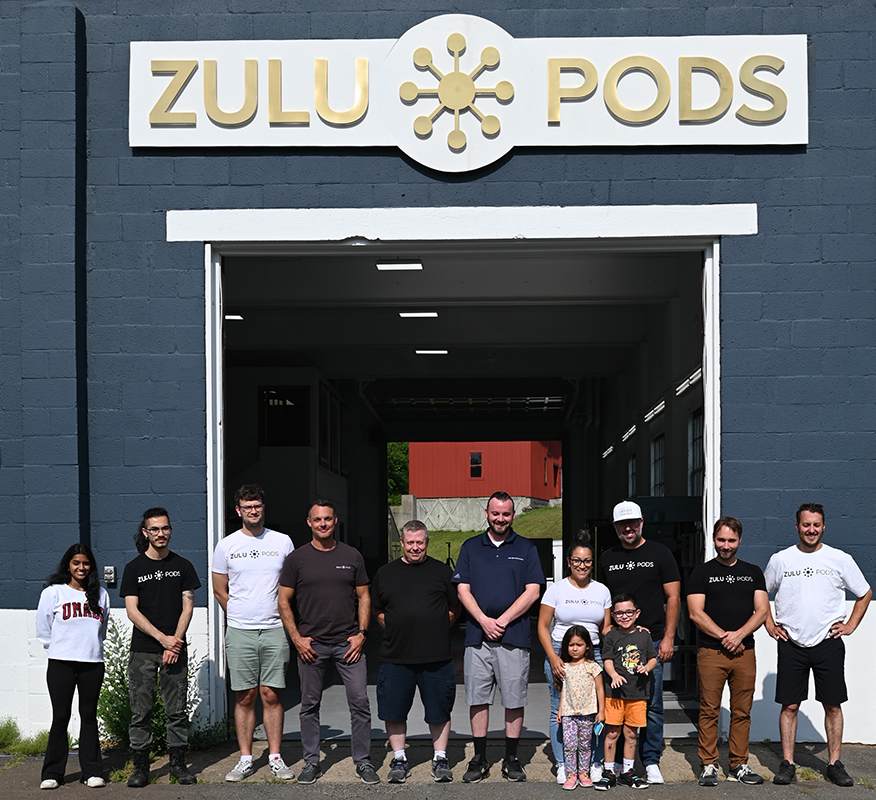
In addition to reducing costs and oil demand, one of our main objectives is to effectively train the next generation of engineers. Our engineers have simulation models that provide a 360-degree view of how to optimize aircraft components’ performance.
What is your proudest moment as a cofounder and CTO of your company? How does your company help employees achieve work-life balance?
My proudest moment was when we rolled out our paid parental leave policy at our company. I am passionate about creating space for more women in the aerospace industry. From my personal experience, I know the challenges of reentering the workforce after having children. When building Zulu Pods, I felt it was important to implement a flexible parental leave policy.
Our employees receive two weeks of pre-birth leave, 14 weeks of post-birth leave, and two weeks of flexible time to transition back to work. This 18-week paid parental leave gives parents some time to adjust to being working parents.
All my employees also have unlimited, paid time off. As CTO, I believe that leading with empathy and realizing that employees are not robots creates a great working environment: When employees feel respected, then they feel a genuine sense of belonging.
What is next for your organization?
Our company is working with some major aerospace original equipment manufacturers to integrate our technology into their engines. We are designing and testing a new engine prototype. We are also expanding and updating our technology by implementing additional sensors with monitoring capabilities. That means the sensors automatically inject the correct amount of lubricant.
Is there anything you would like to tell our members or young girls who want to have careers in STEM?
There is an unseen barrier facing women and girls who want to enter STEM. Talk to inspiring professional women already in the field for support and guidance. Professional networks like AWIS and LinkedIn are vital for career advancement since they help you meet relevant and influential people. Existing women scientists and engineers should always work to inspire young girls.
 Shruti Shrestha is an Assistant Teaching Professor of Physics at Penn State Brandywine. She is a particle physicist who worked on the High Voltage Monolithic Active Pixel sensor for the Mu3e Experiment. She also conducts free STEM workshops in the Philadelphia area to empower girls to pursue STEM degrees.
This article was originally published in AWIS Magazine. Join AWIS to access the full issue of AWIS Magazine and more member benefits.