

In June 2024, Elsevier released its Progress Toward Gender Equality in Research and Innovation – 2024 Review, an analysis of women’s participation, contributions, and career progression in STEM and related fields over the past two decades. Kumsal Bayazit, Elsevier’s first woman CEO in its 144-year history, referred to the review’s goals of tracking the past and current landscape and of illuminating a path forward by recalling the words of Dr. Marie Curie: “One never notices what has been done; one can only see what remains to be done.”
Ms. Bayazit went on to say that “there is progress, but it is slow. At the current pace of change, equality remains too far away and further action is needed to accelerate change. Our hope is that the rich insights in this report, together with the extensive data available on the companion Gender Dashboard, will help stimulate dialogue, sharing of best practice[s] and inform targeted interventions to support women researchers and innovators.”

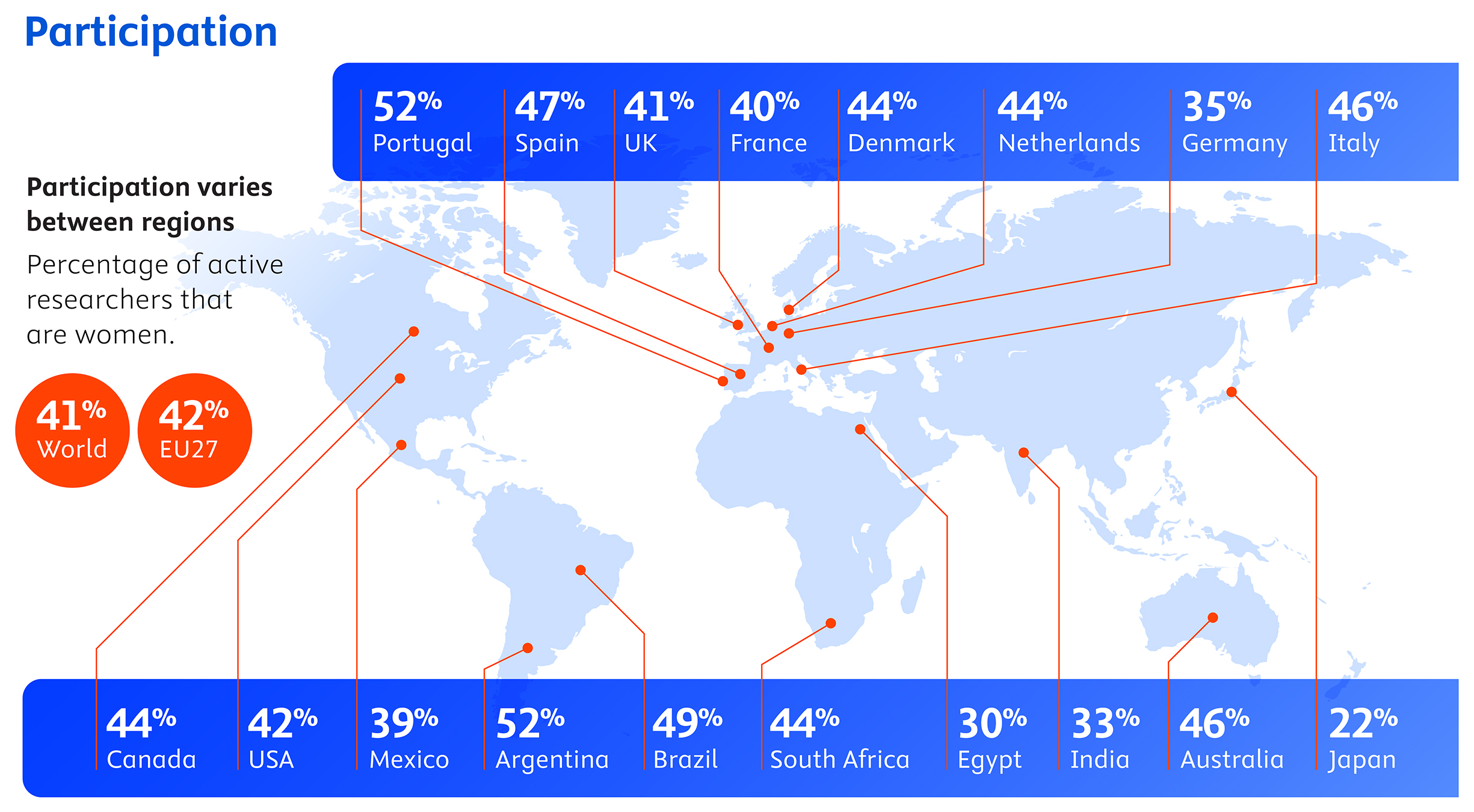
According to the report, women now account for 42% of active researchers in the United States and for up to 52% of researchers in other countries (Figure 1). However the report also emphasizes that continued forward momentum depends crucially on STEM and its affiliated fields leveraging the entire talent pool, including women and others who are underrepresented, for society to effectively address the increasingly wicked problems that we face. Such complex issues as our climate and sustainability crises demand diverse perspectives and approaches.
Data in this comprehensive review spans 17 indicators that represent research and grant participation and research culture, output, outcomes, and impact. It covers 18 countries (with the 27 countries of the European Union counted as one in some scenarios) and 2 regions from 2001 to 2022. The 17 indicators are drawn from Elsevier’s The Future of Evaluation: Emerging Consensus on a More Holistic System. They include grant applications, patent filings, and policy and media citations. The data dashboard that accompanies the review filters the results according to several indicators including research impact, publications that are uni-disciplinary, multidisciplinary, or open access, and participation in the United Nations’ Sustainable Development Goals (SDGs).
Infographics, a recorded webinar, and a case study of Portugal—where, along with Argentina, women represent 52% of active researchers—also accompany the written review.
Good News
Over the past two decades in all STEM and related fields, the status of women researchers has become promising, according to the report. Globally, women made up 41% of active researchers in 2022, up from 29% in 2001. In the United States, women’s representation among active researchers increased from 28% in 2001 to 42% in 2022. Worldwide, women’s representation in some life science fields—immunology, microbiology, neuroscience, biochemistry, genetics, and molecular biology— is now approaching or is at parity (45% to 52%) with men’s. The rate of U.S. women’s open-access gold publications in STEM (at 44%) continues to outpace that of men (at 37%) and mirrors the global trend.
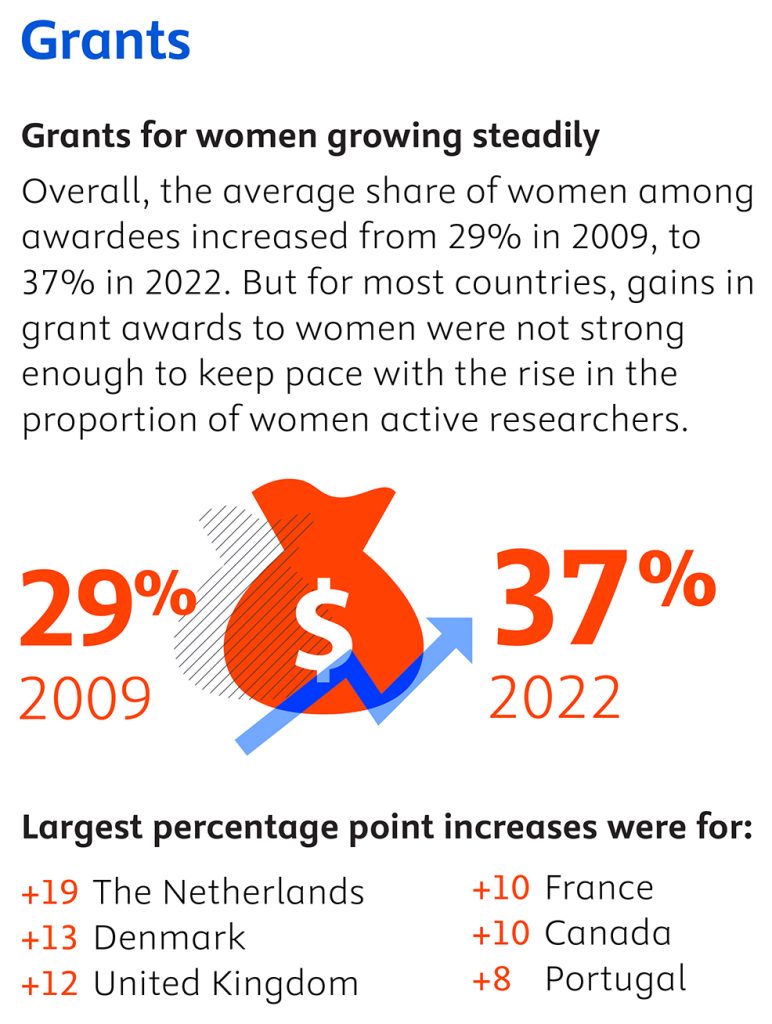
Although men’s publication citations still outpace those of women (except for advanced-career women), women’s citations in policy documents and media surpass those of men, and their progress is particularly strong in multidisciplinary research in most science fields, for example, women outpace men in 10 of the 17 SDGs (Figure 2). Women’s share of research grants has also climbed from 29% in 2009 to 37% in 2022 (Figure 3); however, this increase has not kept pace with the growing percentage of women researchers in most countries.
News That Demands Improvement

Although women’s representation has grown at all career stages, the increasing attrition of women along STEM career progression persists. The report notes that the percentage of women in STEM roles drops from 42% in early careers to just 26% in advanced career stages. Gender inequity still plagues many STEM fields; for example, women researchers in the physical sciences make up only 33% of the total, and their participation in fields ranging from computer science to mathematics is below 30% (Figure 4). While the average number of published papers has increased for both men and women, the gap between the two genders has remained consistent over the past two decades (Figure 5). Women, in their efforts to translate their research into innovative applications, receive only 26% of all patents, with women-only teams accounting for just 3% of patent applications (Figure 6).
Recommendations
Elsevier’s review does not merely examine progress to date: it also recommends five actions that academia and industry should take to hasten the achievement of gender equity in STEM research.
- Accelerate commitments and programs to recruit and retain women.
- Prioritize the retention of early career women into mid and advanced careers.

Figure 5. Average number of published papers. Progress Toward Gender Equality in Research and Innovation – 2024 Data Dashboard - Develop incentives for women to successfully walk the path from research to innovation, supporting them in their efforts to obtain patents and other intellectual property.
- Broaden indicators to measure research effectiveness to include those that factor in policy and societal impact.
- Continue to track and report diversity and inclusion data to monitor progress, identify gaps, review policies, and drive accountability.
Looking back at all the work that went into this report, Bayazit said, “Along this journey, we had many moments of joy as we celebrated progress but also moments of frustration by the slow pace of change and how much work remains to be done.” She added, “Taking our inspiration from Marie Curie and the legions of talented women scientists before and since, we have sought to both ‘notice what has been done’ and what ‘remains to be done.’ We invite you to share your feedback and thoughts with us as we continue to work with all stakeholders in the research community towards the goal of achieving greater inclusion, diversity and equality in research and innovation.”

Editor’s Note: The contents of this article are not affiliated with the Howard Hughes Medical Institute (HHMI).
 Patricia Soochan is a senior program strategist in Data Science, Research, and Analysis in the Center for the Advancement of Science Leadership & Culture at HHMI. In her role, she collaborates with the Center’s programs to capture, analyze, synthesize, and communicate program-level data to promote organizational effectiveness and evaluation. Previously she shared lead responsibility for the development and execution of the Inclusive Excellence (IE1&2) initiative and had lead responsibility for science education grants provided primarily to undergraduate institutions, a precursor of IE. She is a member of the Change Leaders Working Group in the Accelerating Systemic Change Network and is a contributing writer for AWIS Magazine and The Nucleus. Prior to joining HHMI, she was a science assistant at the National Science Foundation, a science writer for a consultant to the National Cancer Institute, and a research and development scientist at Life Technologies. She received her BS and MS degrees in biology from George Washington University.
This article was originally published in AWIS Magazine. Join AWIS to access the full issue of AWIS Magazine and more member benefits.