

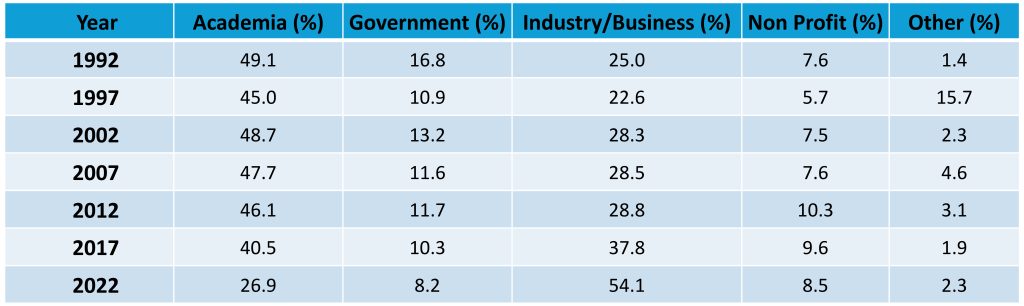
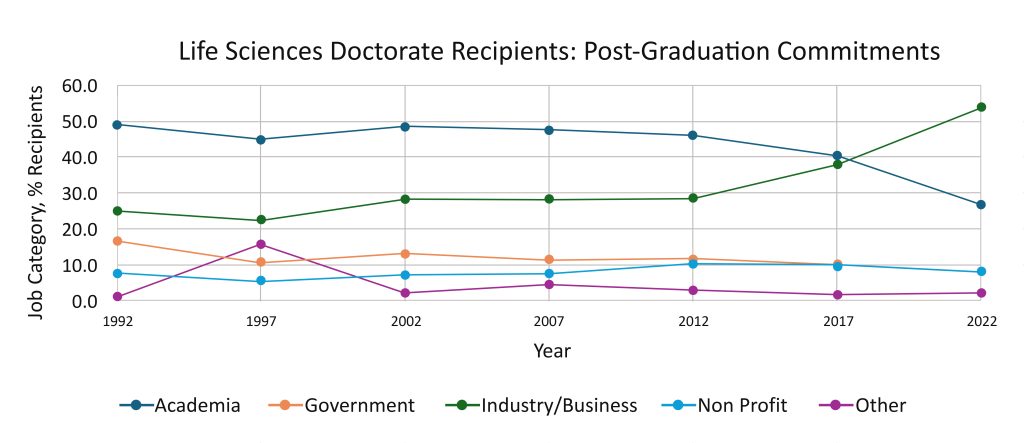
What persuades a PhD graduate in life sciences to choose industry over academia or vice versa? In the 30 years spanning from 1992 to 2022, the percentage of graduates who reported committing to an academic position dropped from 49.1% to 26.9%. During the same period, graduates who accepted industry positions reflected the reverse trend, with their commitment increasing from 25% to 54.1%. It’s not surprising that industry jobs are the more attractive option, given the difficulty in landing NIH funding, the low wages earned by postdoctoral fellows, and the limited number of faculty positions in academia. In the past, nonacademic roles were “alternative” or “non-traditional” careers for PhDs. Now we can say that industry roles, and in particular, non-bench roles, are long overdue for full recognition as career paths for PhDs.
To meet changing trends and current needs, career development offices at universities must provide resources and guidance to students and postdocs who want to explore options outside of academia. In addition, faculty who train graduate students and postdocs must be more supportive of the choices their trainees make. It’s just not acceptable when, in light of today’s academic job and funding environment, a mentor tells a talented young post-doc how disappointed they are because that post-doc is choosing an industry position.
My Different Career Path: Field Applications Scientist/Specialist
After my postdoc training at the Donald Guthrie Foundation for Medical Research (Laboratory of Molecular Biology), I took an industry role at a small biotech company as a Scientist in the Research and Development group. I later transitioned into a non-bench industry role at Roche Applied Science as a Field Applications Scientist (FAS), a role that explains scientific concepts and enables Life Sciences researchers to successfully adopt new technologies. This Field Applications Scientist/Specialist (FAS) job was a stepping stone to a fulfilling, 17-year career in the biotech sector. I built and led teams, had the opportunity to work with large, small, and midsize organizations, and held a number of different positions.
After starting in my first FAS role, I was promoted to manage a US-based FAS team. Over time, I added more responsibilities, leading both a call center team and the FAS group. Seeking new challenges, I switched to BD Diagnostics. There, I led call center and dispatch teams. Across various companies, I grew into management and senior management roles. I learned how to lead technically diverse teams, solve technical and nontechnical problems for customers, develop crucial business skills, and hone my ability to collaborate cross-functionally. These experiences, including a stint in marketing, paved the way for me to start my own company, AccelSci Consulting, in 2023. AccelSci Consulting’s mission is to connect people and technology to advance discovery. To accomplish this, I partner with biotechs to ensure successful user adoption of their innovative new technologies.
What Does a FAS Actually Do?
Many FAS roles involve showing customers how to use an instrument and its accompanying software. This is the area I’m experienced in, so my writing is based on this knowledge. In general, all FAS activities fall into two buckets—what the FAS does to help win a sale and what the FAS does after a sale. Let’s break that down.
Before the Sale
In this mode, you’re working with a customer as they’re making up their mind about whether to purchase a product. Your FAS role is important for making the sale because you explain the science and show them why the technology is the perfect solution to solve their problem.
In a typical pre-sales scenario, you interact with the potential customer. This can involve several meetings, either onsite or virtually, during which you explain your company’s technology and ensure that it can deliver what the customer needs. Pre-sales may also involve a wet demo, where the customer sends samples to a central lab location or an instrument is brought into the customer’s lab. In the latter scenario, the FAS is quite busy. You could start the day off by presenting an overview of the instrument and answering questions about it and then show the customer how to run samples and analyze the data. Later, the FAS may follow up with a demo report, showcasing all the results.
After the Sale
Depending on the complexity of the instrument, the FAS is likely the person who installs and calibrates it, in addition to training the customer in its use. As the FAS, you’re the main point of contact for communicating with the customer on logistics, the installation timeline, and training agenda.
Your FAS responsibilities are not done once training is complete and you walk out the door! In fact, you are responsible for following up to ensure that the customer’s operation is up and running smoothly. An unhappy customer is someone who will neither use your consumables nor recommend your technology to their pals. Just like selling a printer and then steadily supplying the customer with inkjet cartridges, when you sell your company’s instrument, the accompanying consumables you provide create a lucrative revenue stream. So, post-install follow-up is critical to ongoing revenue generation for your company. Follow-up may involve jumping on a video call or going on-site to review data and provide additional guidance on software or instrument usage and data analysis. This ensures a good experience for the customer and helps them successfully incorporate the new technology into their workflow.
What Qualifications Should an FAS Have?
Technical Skills
Clearly you need to be strong scientifically to be considered for FAS roles. Job descriptions outline the areas of expertise candidates should have. Typically, you must have hands-on experience in the subject matter. However, if you have a good scientific foundation, an organization may be willing to train you on the basics and build from there.
Having publications that point to your accomplishments is great. However, when I interview FAS candidates, I probe their ability to concisely and articulately explain the research they’ve done. FAS employees spend their days showing and explaining, so being clear and concise is important. In fact, the entire interview gives a candidate the opportunity to demonstrate these skills, rather than to just answer questions about a technical or scientific point. While many FAS roles require a graduate degree, there are also jobs for those with undergraduate degrees, especially for candidates who have lab expertise in the area that the hiring company needs.
Soft Skills
The reality is that technical skills aren’t enough to be a successful FAS. Below are some key skills that I’ve seen outstanding FAS team members demonstrate:
- Communication
Their explanations are clear and concise. They can break down complex concepts so that they’re easily understood.
- People Skills
They come across as friendly, engaging, easy to talk to and approachable. They are good listeners. They are practiced at asking clarifying questions that help them tailor an answer or explanation.
- Prioritization/Organizational Skills
They are able to manage competing demands on their time.
They can cope with multiple deadlines.
Your communication and people skills will come across when you interview, but you should be prepared to give examples that showcase your prioritization and organizational skills.
Is the FAS Role for You?
The FAS role is challenging but motivating and satisfying. You will typically work independently. You’ll set your own schedule, train customers on innovative new technologies, and resolve issues for customers in the geographical area you’re assigned to. You’ll collaborate with your sales colleagues to land sales and new customers. You will usually work remotely out of your home office. Your manager will hold regular virtual meetings and travel in the field with you from time to time.
You will talk constantly to scientists and learn about cutting-edge innovations. You will be challenged to think on your feet, and you’ll gain valuable business expertise along the way. You’ll be able to survive downturns and the inevitable layoffs in the biotech sector. I say this because I’ve seen it, and certainly in my journey, the FAS experience has allowed me to successfully leverage opportunities to spring into other industry roles, such as sales or marketing or leadership.
What are some additional things you should consider?
- Pay—Compared to typical postdocs, FASs receive good pay. It’s not unusual to start in the high-five or low-six f igures. In addition, at some companies, FASs also receive a commission on their sales revenue. This can add up to a nice sum each month that’s above their base salary.
- Travel—FASs typically travel a lot. It’s not unusual, based on where they’re located, to travel 50% or more each month, and that’s with overnight stays.
- Customer focused—FASs need to like being around people. The best FASs just love being helpful and are motivated to solve customers’ problems.
A Few Tips
If you think the FAS role is for you, here are some additional pointers to help you prepare:
- I’ve interviewed many candidates who were outstanding technically but fell short on their soft skills. This is important: you won’t be hired as a FAS on the basis of your technical ability alone. If you’re interested in the FAS role, start thinking about the initial soft skills mentioned in this article and about how you can showcase them. Look for ways to start practicing if you need to.
- Talk to FASs to find out about the role. One way to do this is to reach out to them on LinkedIn. Not everyone you ask will help, but be patient—you’ll get enough responses to gather useful information. Another approach: When vendors come through your lab, ask if their company has FAS employees, and ask if you can have their contact information.
- Look at job postings to see what qualifications companies are asking for, and start thinking about how you could demonstrate your abilities to take on one of these roles.
- Turn your CV into a résumé. The key difference between the two is that a résumé is shorter (1–2 pages). Be sure to include volunteer activities and jobs you’ve held. You can use these to highlight your customer-facing skills or leadership skills, which can set you apart in the screening and interview process.
Good luck on your journey. Remember, choosing to leave academia, whether it’s for a FAS role or something else, means you’ve opted to redirect your talents and abilities. With preparation and planning, you can make the leap and land on your feet.
 Dr. Indira Carey earned her PhD in Biochemistry and Molecular Biophysics from the Medical College of Virgina/Virginia Commonwealth University. Her career in the Biotech sector spanned 17 years, where she held various positions including Field Applications Scientist and Marketing roles. Dr. Carey has more than 10 years of expertise leading Field Application Scientist and Technical Support Teams. She is the Founder of AccelSci Consulting LLC, which partners with biotechs to accelerate discovery by connecting people and technology. Connect with her on LinkedIn.
This article was originally published in AWIS Magazine. Join AWIS to access the full issue of AWIS Magazine and more member benefits.