

Is there anything more sustainable than nature itself? I think not! In fact, it is nature itself that defines what is and isn’t sustainable on our planet. So how might we replicate nature’s amazing—and sustainable—adaptations into our design solutions? The key is biomimicry.
In the words of Denise DeLuca, an expert on this concept and the owner of Wild Hazel, “Biomimicry is the practice of looking to nature to design products, processes, and policies that reflect nature’s strategies and rules for sustainability.” DeLuca’s company aims to help people connect their lives to their values and to nature. She goes on to elaborate: “The premise is that evolution reflects extremely rigorous quality-control standards—less than 1/10th of 1% of all species that have ever lived on earth are around today. Those that have survived and that share the earth with us know how to live within the limits and boundaries of the planet, as well as how to live with each other.”
 Biomimicry, simply understood as innovation inspired by nature, is often confused with other forms of nature-inspired design. Biomorphic design, for instance, is used to create a lamp that looks like a flower. Employing biological organisms themselves to accomplish desired functions, as we do in wastewater treatment plants when we use microorganisms to remove pollutants from the water, is called bio-utilization. In bionic engineering, living systems are replaced with manmade mechanical systems, like a bionic limb that interfaces with the neuromuscular system. The list goes on. Biomimicry is unique in that its overarching goal is sustainability—and you get radical innovation as part of the process.
How does it work? DeLuca explains: “You begin by breaking down your design goal into its core functions. Then you discover nature’s strategies, processes, and systems for performing those functions, emulate the strategies to create innovative design solutions, and finally evaluate your design against nature’s rules for sustainability. The process is repeated with multiple functions, strategies, and design concepts.”
The processes of breaking design goals into functions and of discovering nature’s strategies require divergent thinking, as opposed to our conventional, convergent thinking. This divergent thinking is where the magic happens and the innovations become radical, because we are no longer bound by how we’ve done it in the past or by our typical problem-solving methods.
One lesson that emerges from this practice is that nature always uses more than one strategy to perform a given function, and every strategy performs more than one function. Feathers are designed to support flying, of course, but they also provide color and patterns, insulation, and waterproofing. And they’re self-repairing because each feather barbule, or filament that fringes the feather, has little hooks that interlock with neighboring barbules. When the barbules of a feather come apart, birds can preen themselves to re-interlock the barbules. When we take this multifunctional approach, we call our designs “smart” or “resilient,” while nature calls this business as usual.
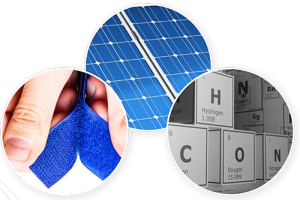 What does biomimicry look like? DeLuca gave me some examples. We’ve all used Velcro. That product emulates the strategy that burrs use to stick to fur. We haven’t been able to mimic photosynthesis, but solar panels emulate the idea of taking energy from the sun and turning it into another useful form of energy. All the incredible things we do with computing are based on a simple binary system. This reflects nature’s strategy of creating complexity from simplicity. In nature, just four elements—carbon, hydrogen, oxygen, and nitrogen—make up more than 95% of all the incredibly complex biomass on earth.
How might scientists and engineers imagine and create sustainable, and even regenerative, designs to meet human needs? DeLuca suggests that the answers are literally in our own backyard. The next time you’re faced with a design challenge, consider turning to nature for sustainable answers. Go outside and ask a tree how it pulls water 100 feet up its trunk, or gets sunlight to its lower branches, or turns the sun’s energy into mass. The answers will be sustainable and might just be radical!
If you’re interested in learning more: Watch Biomimicry’s surprising lessons from nature’s engineers, an inspiring TED talk by Janine Benyus, author of the book Biomimicry: Innovation Inspired by Nature.
Explore AskNature, a portal to nature’s wisdom that allows you to learn strategies that myriad organisms use to perform specified design functions. It also showcases examples of what others have designed by asking, or turning to, nature.
Listen to Learning from Nature: The Biomimicry Podcast with Lily Urmann, a biomimic, educator, and nature communicator.
Read “The Power of the Biomimicry Design Spiral,” an article written by Denise DeLuca that describes the Biomimicry Design Spiral and how the spiral process can be used to drive radical innovation.
 Meleah Ashford is a water resources engineer with a BS from Oregon State University and an MS from University of California at Berkeley. She worked in industry for 30 years, most of her career as an engineering consultant. Ashford is now a certified Life Coach with Find Solid Ground Coaching where she helps people meet goals related to financial well-being, starting a business, living the life they desire and being a women in STEM. She has owned two businesses; an engineering firm and a life coaching business. Meleah grew up in rural eastern Oregon and now lives in the Oregon’s Willamette Valley.
This article was originally published in AWIS Magazine. Join AWIS to access the full issue of AWIS Magazine and more member benefits.