

Laura Guertin is a Distinguished Professor of Earth Sciences at Penn State Brandywine and an honorary fellow of both the Geological Society of America and the American Association for the Advancement of Science. She researches innovative and effective uses of new and emerging technologies to enhance teaching and student learning in the introductory-level college classroom.
In addition, she has received a U.S. Congressional Citation for her civic and community engagement efforts and a United States Senate Certificate of Special Recognition for her contributions at sea with the National Oceanic and Atmospheric Administration (NOAA). Fueled by her passion for science outreach, she uses creative approaches like quilting to engage audiences in learning about earth science and its applications. Our conversation focused on what it means to be a woman role model in earth sciences, on Guertin’s own contributions to STEM, on how she has inspired and motivated women working in STEM, and on her efforts to encourage young women students to have scientific careers. Our edited conversation is as follows.

Your area of specialty in geoscience is marine geology and geophysics. You have been on many oceanographic field expeditions. Recently, you took a two-month trip to the South Atlantic Ocean on the research ship JOIDES Resolution [JOIDES stands for the Joint Oceanographic Institutions for Deep Earth Sampling]. What was the primary objective of this expedition, and what was your role?
The JOIDES Resolution is a research vessel [for scientists who drill] into the ocean floor to collect and study core samples. We use the data to better understand topics such as seafloor spreading and plate tectonics, to define a record of global climate history, and to learn about the sub-seafloor microbial biosphere. This research vessel is part of the International Ocean Discovery Program, managed by the United States and financially supported by nations across the globe.
I was a part of JOIDES Resolution Expedition 390 from April to June 2022. One [of our objectives] was to quantify the timing, duration, and extent of hot fluid moving through the aging ocean crust. The other one was to investigate the evolution and diversification of microbes living in the sediment and crustal rocks. My primary role was as an Onboard Outreach Officer, writing for the ship blog and updating our activities on social media, as well as conducting ship-to-shore Zoom connections with classrooms and community groups to share our process of [conducting] science at sea. Interestingly, even though I joined the ship to work on science education and outreach, my marine geology background came in handy because I helped in the laboratories with some data collection when there were limited scientists who could join the ship due to the COVID-19 protocols. This ship has contributed so much to our knowledge about the ocean, and I am thrilled that I have had the opportunity to sail on JOIDES Resolution and on additional research vessels.

To maintain and improve the quality of life on this planet and to protect threatened environments and ecosystems, we depend on geoscientists and their knowledge, experience, and ingenuity to meet society’s demands for natural resources, environmental quality, and resilience to hazards. That means earth science empowers us to think globally and act locally. Hence, it is a versatile discipline. Many categories fall under the umbrella of earth science, including geology, meteorology, oceanography, and astronomy. What careers and opportunities are available for earth science majors?
There are so many options; it is exciting to explore and envision! Although I have been discussing fieldwork, [I don’t mean to suggest that] you need to do this to be a full-time earth scientist. Earth scientists work in laboratories processing samples, do computational work on developing models, and utilize ArcGIS, a Geographic Information System software used to analyze geographic data to understand spatial and temporal relationships of the earth’s processes.
I encourage my students to think about interdisciplinary connections, such as earth science and policy, earth science and health, and even earth science and art. Traditionally, we teach our subjects in silos, and we ask students to [narrowly specialize] when they pick a major. But for students interested in non-STEM fields, there are many opportunities for research and careers that cross these boundaries and which can lead to significant innovations and solutions to some of the grand challenges we see on Planet Earth.
Men vastly outnumber women majoring in most STEM fields in college. The gender gap is high in computer science, earth science, and engineering. What inspired you to become a geoscientist?
Growing up, I never had an interest in pursuing a career in STEM—my dream job was to be the piccolo player in the Boston Pops! Although I clearly remember an experiment we did in my fifth-grade class with radish seeds that was an ah-ha moment, that excitement—coming from doing science with a hands-on activity—did not activate again until many years later. But in my junior year of high school, I had an inspirational chemistry teacher who was the first to tell me that I was good at science and who encouraged me to go to college to pursue chemistry.
I started college as a chemical engineering major at Bucknell University, but having organic chemistry in the first semester of my first year was incredibly rough. Utilizing resources at the career services center on campus helped me to see that I was still very interested in science, but I needed to find the right field. When I took my first geology course in the second semester of my sophomore year, I could not have been happier. The department was welcoming, and I knew I had found my disciplinary home!
I do not recall any student clubs or efforts to promote and support women in STEM in college or at the University of Miami – Rosenstiel School of Marine and Atmospheric Science, where I attended graduate school. Further, it was not a topic of conversation among the women in my programs in the late 1980s and early 1990s—at least not publicly. I now realize how fortunate I was to be among [peers] … in my undergraduate and graduate cohorts … to be [surrounded by] students who supported one another and truly worked as a team in the classroom and out in the field.
Women’s underrepresentation in STEM is often portrayed in terms of a lower proportion of women in faculty positions and is attributed to a chauvinistic ideology of viewing women as less competent than men counterparts with similar qualifications. Geoscience is one of the least diverse STEM disciplines by gender and race. Did you experience any gender bias?
One item essential to note when looking at women’s representation in the geosciences is the percentage of women who complete an undergraduate degree in geology. For many years — going back to when I was an undergraduate student — both enrollment and graduation rates in the geosciences have been equal between men and women. However, if you [observe] … the career trajectory of academics, or even of people in technical fields, you see an increasing number of women leaving geoscience in the years after obtaining their degrees. One of the reasons is that there are still departments and individuals in organizations that are unwelcoming and have an exclusive culture. And the microaggressive (at times macro-aggressive) behavior does not always come from men in STEM. For example, in my first year at my current position, I had two nonSTEM men faculty members ask me on multiple days, and every single week, where their coffee was in the morning, [joking] that I should have the coffee ready for when they arrived because I was the first person to come in the building. They thought it was funny — I did not. One, I was not the first person since there was always a man on the engineering faculty who arrived before me in the morning. He was never asked about the coffee. Two, I do not even drink coffee, so it wasn’t like I was making it for myself and not leaving enough for them.
Since geoscience research can involve spending much time in the field, it is challenging for women geoscientists to have a work-life balance. Furthermore, there is the possibility that the research field is in a remote location, or that you might be the only woman on a field team. Hence, the inflexible and demanding work environment makes it difficult for women to balance work and family roles. As a result, they have no choice but to leave the geosciences and to find a more supportive professional community.
You have been a Chair of the Geoscience Division of the Council on Undergraduate Research (CUR) and served as a Councilor-at-Large with the National Association of Geoscience Teachers (NAGT). Can you describe the resources these organizations provide for faculty and students? What advice would you give other women exploring Geoscience and STEM careers?
I have been involved with both organizations since I was a graduate student. In graduate school, I was a teaching assistant for the undergraduate geology department, taught laboratory classes, and was a substitute lecturer.
I attended workshops offered by NAGT to [improve] my teaching. I found the workshops helpful and the community supportive. I became a member and still learn so much from this group! The Geoscience Division of CUR also offered workshops for [prospective] faculty in my discipline [that focused on how to get] started mentoring undergraduate research students, how to sustain a research program with students, etc. As I knew I would be searching for a faculty position, I hoped these workshops would provide me a foundation to start mentoring students right away — and they did!
It is essential to mention how much mentoring both organizations offered me, not just through the workshops but also by providing professional support. For example, they provided potential external reviewers for me to list while I was going through the tenure and promotion process.
Hence, I strongly encourage graduate students and early career researchers to look for organizations to be a part of. They will help you grow your networks, and trust me, you will grow as an individual in more ways than you realize are possible. I have volunteered to serve in leadership roles in these organizations and others—I want to give back to those who gave me so much. Networking can help you learn about new job opportunities, gain career advice, and increase the possibility of being recommended for positions.
I want to mention additional organizations [in our discipline] that have provided a community where I feel safe and supported as a woman geoscientist, such as the Association for Women Geoscientists and the Earth Science Women’s Network. I am excited to be a part of ocean-themed organizations as well, such as the Society for Women in Marine Science, Women in Ocean Science, and the Women’s Aquatic Network. All these groups are volunteer-run and are working hard to increase the level of participation of women in the marine sciences in a safe and supportive way.
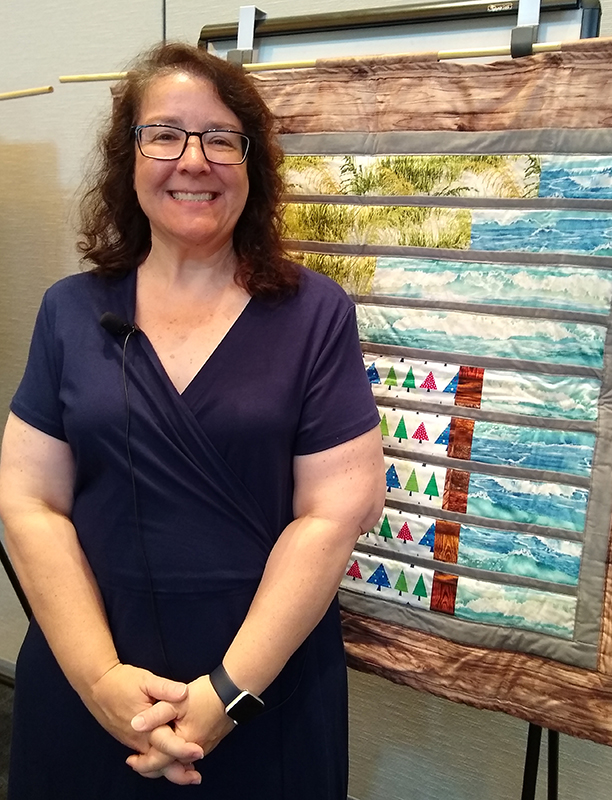
Besides teaching various earth science courses and mentoring undergraduate students in research, you have merged your hobbies of crocheting and quilting with your science background. In October, you presented “A Crochet to Showcase Temporal Patterns in Temperature Records” at the Women in Science: Opportunities program at Jenkins Arboretum in Philadelphia, hosted by the American Philosophical Society. What inspired you to use crocheting and quilting to share science stories from your ocean explorations? How do you implement this in your teaching?
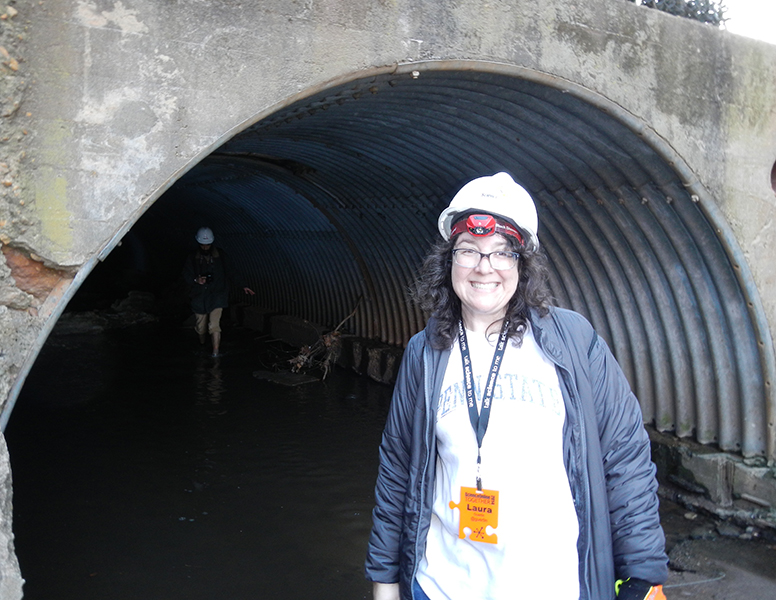
My journey to bring my hobbies into my science teaching and outreach efforts has been fascinating. In the 2013–2014 school year, while I was on an academic sabbatical, I attended three science communication conferences. Among them was the Science Online Together conference in Raleigh, North Carolina. There was a field trip to tour an underground stormwater tunnel. I had two field trip leaders, one a scientist and the other an author. Being at the site and hearing them explain the function and purpose of the impaired streams and other features in two different ways was so impactful and had me reflecting on other ways to communicate science topics and processes.
Then in 2017 I first learned about temperature blankets and about how some crocheters note the daily maximum temperature value and crochet a row in a specific color [to reflect this value], repeating this process every day for an entire year. I wanted to implement this idea, so I started diving into the NOAA archives to see how temperature has changed in Philadelphia over the past 100 years, [and I made my own blanket]. I showed my students my crocheted temperature records. I found them engaged and quickly able to observe the data presented in yarn rather than on a line graph. Hence, I continued using yarn for data visualizations.
I quickly added quilting as a tool for telling science stories. When I attended the OCEANDOTCOMM event at the Louisiana Universities Marine Consortium in 2018, [I heard] local community stories [told by] coasters, [and their] optimism inspired me to find a new way to share their efforts in coastal adaptation and resilience. Initially, I faced challenges, as I had never attempted to tell a story through a quilt, and no patterns existed for the stories I wanted to tell! But through careful drafting of designs and fabric selection, I made my first quilt collection of science stories, which I titled Stitching Hope for the Louisiana Coast. Today, I continue to generate science stories through quilts, including quilts based on my oceanographic research expeditions.
Your quilt called Looking Out at the Ghosts on the Coast, which is 25 inches long by 29 inches wide, is selected as part of the juried art exhibit at Chesapeake Bay Maritime Museum in St Michaels, Maryland. It will be in the exhibition until 2024. What scientific message are you conveying through this quilt?
This piece is my first time merging crocheting and quilting into one item! The Chesapeake Bay Maritime Museum had asked artists to submit their works in the form of photography, paintings, poetry, sculpture, and quilts for The Changing Chesapeake community exhibition, which focuses on how climate change and humans have impacted the region. Ghost forests and woodlands that have died are topics I have been following closely for years and in different geographic areas.
In the past, I have completed a few quilts using the “attic window” template, and [for this project, I envisioned using the pattern to show windows framing] dead trees; it immediately reminded me of a ghost forest, which I themed my quilt around. This quilt work also reminds the viewer of actions they can take to address our changing climate since everyone is part of the solution.
You also received the Association for Women Geoscientists Outstanding Educator Award in 2022 for your significant contributions to the education and support of geoscientists within and beyond the classroom, particularly for advancing the persistence of women and underrepresented minorities in geoscience careers. Describe your current role. What do you consider to be your most important career achievement?
I am the only geoscientist faculty member at Penn State Brandywine. I teach introductory-level geoscience, earth science, and geography courses for non-STEM majors since most students who intend to complete a geoscience degree transfer to Penn State’s main campus. For most of my students, I will provide their first and only academic exposure to my discipline. My responsibility is to increase the science literacy of these students, help them make the connections, and see the relevance of earth science to their lives.
[In addition to teaching], I engage in the other parts of the academic triangle: research and service. Both activities have changed throughout my career, as has my level of involvement. For example, my research agenda has shifted from what some might call traditional science to pedagogical research, exploring how educational technology can enhance student learning in introductory level geoscience courses. Most recently, I have added creative accomplishments to my portfolio, generating quilts as a tool for science storytelling.
Recently, a student came up to me after class and mentioned [her plan to enroll] in one of my classes in the coming semester since she is learning so much in my course. It will be the third course she has taken with me. Nothing is more rewarding than knowing and seeing evidence [of my impact on someone’s life] like this. It is one of the most important accomplishments I could make. Nothing brings me more joy than when a new generation of young and dedicated students, especially the non-STEM majors I teach, learn and share their knowledge [of subjects like] the relationship between geoscience and society.
Your innovative contribution to sharing science through quilting exemplifies the mutual relationship between creativity and STEM. Do you have any recommendations for parents about how to find creative ways to connect children to science and how to encourage them to explore STEM fields?
I am so glad that you are asking this question because I do not give enough shout-outs to my dad for his role in my becoming a marine geologist and staying in the field. He was very supportive and encouraging. When I was in the fifth grade, I remember my dad doing a computer class with me, a parent/kid class in learning how to program in the LOGO computer language. So, if there are any parent/child events that they can participate in together, even if it is a one-day event, trust me, these memories and positive experiences stay with the child!
I know that not every family can participate in programs or classes outside of school, as these events may not be accessible financially or f it in around work time. Even asking your child what they are learning about science in school is a window of opportunity to show support. Pay attention to when a child says something science-related, and ask a follow-up question to spark a discussion. Make observations in the environment around you about the sky, the grass, and the temperature outside. These are great prompts for discussion, for asking questions, and even for looking up the answers together!
It is important to emphasize that mistakes are part of the learning process. Creating a supporting atmosphere at home makes children want to explore their interests in STEM without fear of failure. Climate scientist Dr. Katharine Hayhoe has a famous TED Talk in which she states that the best thing we can do about climate change is to talk about it. I think the best thing parents can do to connect children with science is the same—start by talking about science!
You have blogs like Journeys of Dr. G and GeoEd Trek, where you had a recent inspirational topic, “When Barbie was a Paleontologist.” How do women in academia benefit from your blogs?
I wish I had access to the current statistics on who blogs. Past data showed that two-thirds of science bloggers are men. We need to do more to elevate and celebrate our women science bloggers. Everyone can benefit from writing blogs, as well as from reading them.
As you stated, I maintain two blogs: one is a more personal blog with a target audience of my students and anyone else interested in the conference, quilting, and field trip adventures of a marine geologist; the second blog is part of the American Geophysical Union (AGU) community. I first blogged [in conjunction with] AGU on geoscience education, educational technology, and science communication as part of my one semester certificate requirements. Later, I continued it since it was a way to connect to the larger geoscience community and to maintain my identity in my discipline. I hope that women in academia are not just learning about innovative teaching techniques and approaches to outreach but that they are also seeing successful women in science sharing material.
Is there anything else you would like our members to know?
I encourage all AWIS members to be open to opportunities to speak about science and their experiences to whomever they interact with, whether a person or a community group. I have had wonderful conversations about earth science and my experiences at sea on airplanes, during classes at the local fabric store, and even with doctors and nurses in the hospital! You are not always aware of the positive impact you can have on an individual and with whom that individual will share your story. These informal, impromptu conversations can continue to expand people’s views of who is a scientist and who gets to do science. Women must know they have a place in science and a right to share in scientific progress.
 Shruti Shrestha is an Assistant Teaching Professor of Physics at Penn State Brandywine. She is a particle physicist who worked on the High Voltage Monolithic Active Pixel sensor for the Mu3e Experiment. She also conducts free STEM workshops in the Philadelphia area to empower girls to pursue STEM degrees.
This article was originally published in AWIS Magazine. Join AWIS to access the full issue of AWIS Magazine and more member benefits.