
Dickens said it best in his novel A Tale of Two Cities: “It was the best of times, it was the worst of times.” This is true of today’s science ecosystem, characterized by countervailing foundational strengths and weaknesses. On the one hand, science is making tremendous advances in research (think, for example, about the rapid development of COVID-19 therapies and about the progress in artificial intelligence). On the other hand, some facets of STEM careers seem to be buckling under the weight of serious problems, such as challenges to getting tenure and persistence in racial bias and sexual harassment. Such challenges contribute to significant mental-health stresses that scientists currently face.
The mental health crisis in STEMM is being reflected nationally. For example, record levels of mental illness in the US led President Joseph Biden, in his February 2023 State of the Union Address, to announce that “tackling the mental health crisis” is one of his top priorities. An October 2022 KFF-CNN poll also indicated the extent of the problem nationally: 90% of US adults thought that there was a national mental-health crisis, as evidenced by the opioid epidemic and mental-health issues in children and teens.
The Evidence
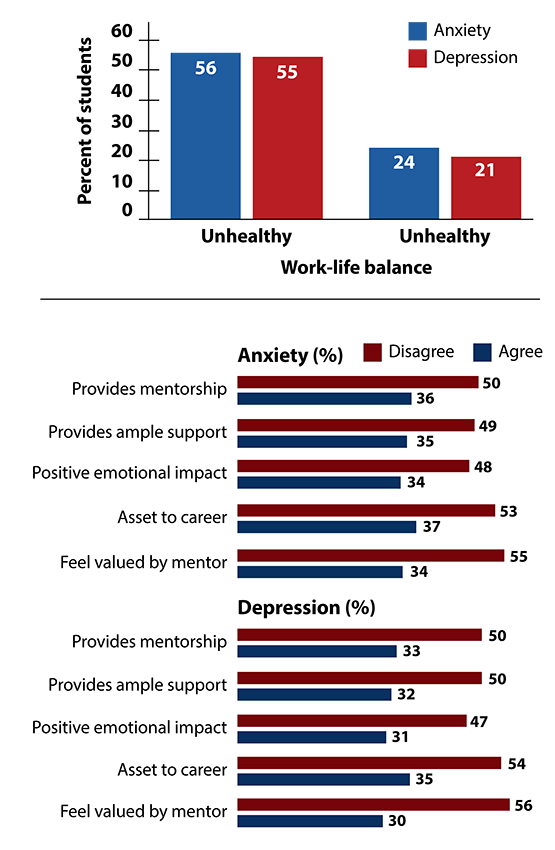
While the pandemic certainly exacerbated problems with scientists’ mental health and well-being, these issues were present long before the pandemic and have been documented in a number of papers. A 2018 study in Nature by Evans et al. revealed that more than 40% of a sample of 2,279 doctoral and master’s students from 234 institutions in 26 countries scored moderately to severely high on anxiety, and close to 40% scored moderately to severely high on depression—rates that were about six times higher than those reported for the general public. In the study, grad students who identified as transgender or gender-nonconforming reported higher rates of anxiety and depression than those who identified with a binary gender. Respondents, however, who struggled with work-life-balance challenges and with establishing good mentor relationships had even higher levels of anxiety and depression (Figure 1).
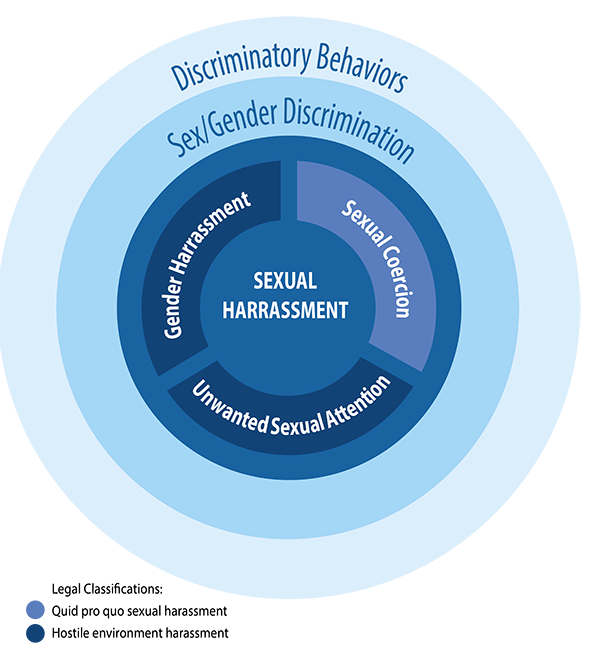
Also in 2018, the National Academies published a report on persistent and pervasive gender and sexual harassment concurrent with the increased participation of women in academic science, engineering, and medicine (Figure 2). The report recognized harassment of women in forms ranging from sexist insults to sexual assault and recommended four categories of action: institutional values, power dynamics, support for targets, and improved transparency and accountability.
In May 2022, Nicholls et al. published a meta-analysis of 26 papers (published 2013-2021) in PLOS ONE on the working conditions of academic researchers, who ranged from grad students to full professors in various disciplines and countries. The result of their qualitative analysis yielded seven interconnected themes and subthemes related to the subjects’ mental health and well-being (Figure 3). All the themes have been reported previously, for example, the incompatibility between work-life balance and the idealized academic lifestyle; and the intense competition for tenuretrack positions. In addition, as can be expected, some themes reverberated more strongly for women and for people from historically marginalized groups, such as: the perceived dichotomy between having children or a career; and feelings of isolation in the workplace.
In January 2023, the National Academies established a roundtable, on mentorship, well-being, and professional development in the STEMM research ecosystem, paying particular attention to impacts on identity, inclusion, personal agency, and mental/financial/social well-being of grad students, postdocs, and faculty. The committee continues to meet through 2023. It will use the perspectives of participating practitioners and researchers to provide innovative examples of supportive services and effective mentorship.
Brave New World
As we moved beyond the crisis stage of the pandemic, it was expected that four years post-COVID, the state of the nation’s mental health would be in recovery. Based on the data, the recovery is either happening more slowly than anticipated or, perhaps like Pandora’s box, there is no going back.
Our first response to reopening may be to try to expedite the process so we can compensate for the ‘lost time.’ As scientists, we are used to quickly generating data to transform into papers and grants.
“However, one important aspect of a successful transition will be to let go of the words ‘swiftly, quickly, and fast’ and replace them with ‘respectfully, safely, and kindly.’ Life changed so rapidly overnight. We were thinking that we would see people the next day, and yet it’s been weeks or months. Many of us may have been sick or even hospitalized, may have dealt with taking care of our families, or are grieving the loss of loved ones. We will all be, to a lesser or greater extent, more fragile and vulnerable.” Dr. Sharon Milgram, Director, NIH Office of Intramural Training and Education (OITE), in the ASCB Career Navigator, July 2020.
About a year after the meta-analysis by Nicholls et al., in May 2023, Shannon Hall published a feature article in Nature urging that attention be paid to the mental-health crisis in science and taking aim specifically at the “toxic elements of the culture of science.” The articledescribed challenges at every science career stage, from poor wages for grad students, through struggles to obtain long-term employment for those in early career stages, and all the way to the unremitting pressure to publish in high profile journals for established scientists.
From Awareness to Action

Fortunately, growing awareness of scientists’ mental-health challenges has created a real push to ensure the well-being of STEMM trainees and practitioners. A few examples are included below.
The NIH’s Office of Intramural Training Education (OITE) provides a plethora of services and programs, primarily for NIH trainees and staff but also for extramural trainees. Featured prominently among its many offerings is Wellbeing, a website offering support to NIH trainees, fellows, and staff, as well as those external to NIH. OITE sponsors a series of webinar workshops aimed at disseminating coping strategies and tools on a variety of topics, such as culture change, perfectionism, suicide prevention, how to become a resilient scientist, and how to avoid imposter syndrome. OITE’s collection of resources also includes small group discussions and individual well-being advising.
Another organization addressing these issues—Dragonfly Mental Health—is a nonprofit that partners with science institutions, such as the University of California, Berkeley’s Molecular and Cell Biology program, and professional societies, such as the American Society for Cell Biology, to cultivate environments conducive to mental health in academic settings. To effect systemic change, Dragonfly uses a five-pronged approach that includes forming a departmental committee, establishing peer networks, providing foundational training in mental-health literacy, offering accessible-skills training, and fighting the stigma of mental illness. Partners ready to engage in this work commit to a comprehensive three-year program, and those who are not quite ready complete a self-evaluation survey that results in a needs assessment and a recommended programmatic road map.
Power Abuse in Academia
“Ultimately what we know from the data is that places that have high levels of harassment, high rates of self-reported and witnessed harassment in them have also very high rates of cultural perception that it’s permissive; that nobody cares at a high level. So, if you’re part of the culture where these topics are openly discussed, you can help reduce the negative, the frequency with which power abuse occurs.
“In addition, make sure that your team members know what to do if they feel mistreated. Give them multiple options because they may not feel comfortable coming to you for a huge variety of reasons.” Dr. Wendy Ingram, cofounder and CEO, Dragonfly Mental Health, AWIS webinar, September 2022.
In addition, several universities have invested in campus-wide programs dedicated to the mental health and wellbeing of their faculty and staff. The University of Michigan, under the leadership of President Santo Ono—a suicide survivor who lives with bipolar disorder—has adopted the Okanagan Charter, which guides an international network of universities and colleges dedicated to promoting health in postsecondary schools. Guided by the charter, the university has also established the Well-Being Collective which boasts more than 50 on-campus and virtual mental-health resources and services. The university also recently created and filled a new position for a chief behavioral health strategist, who promotes the mental health and well-being of the school’s faculty and staff.
École Polytechnique Fédérale de Lausanne (EPFL), a Swiss-based institute of technology, has its own innovative program, a Trust and Support Network available for its 17,000 students and employees. The network’s mandate is to provide assistance in situations of harassment or discrimination, or for other psychosocial risks to physical and mental health, such as professional burnout. Under an umbrella of resources called Community and Support, EPFL offers support for mental health and well-being, LGBT+ members, and work-life balance, including a stop-the-clock program for new parents.
Hopefully, these organizations, now at the forefront of investing in real support for the mental health and well-being of future and current scientists, will serve as models to build a culture of caring that strengthens the science ecosystem.
 Patricia Soochan is a program officer and member of the multidisciplinary team at Howard Hughes Medical Institute (HHMI), with primary responsibility for the development and execution of the Inclusive Excellence (IE1&2) initiative. Previously she had lead responsibility for science education grants provided primarily to undergraduate institutions, a precursor of IE. She is a member of the Change Leaders Working Group of the Accelerating Systemic Change Network and is a contributing writer for AWIS Magazine and The Nucleus. Prior to joining HHMI, she was a science assistant at the National Science Foundation, a science writer for a consultant to the National Cancer Institute, and a research and development scientist at Life Technologies. She received her BS and MS degrees in biology from George Washington University.
Editor’s Note: The contents of this article are not affiliated with HHMI.
This article was originally published in AWIS Magazine. Join AWIS to access the full issue of AWIS Magazine and more member benefits.